
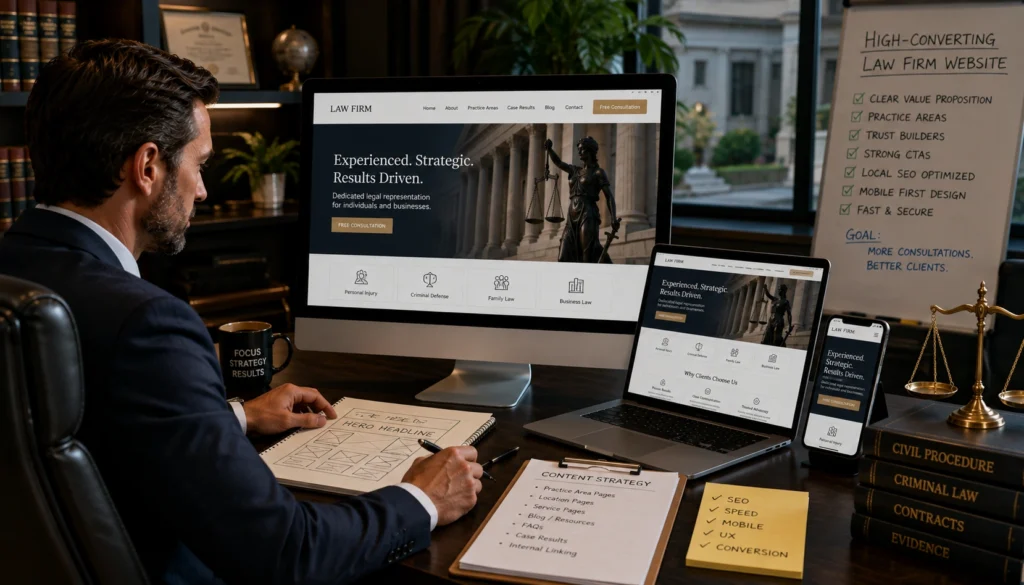
Attorney website design that actually works combines three things: a mobile-fast, conversion-focused build; content written for the questions real prospects ask; and technical signals , structured data, accurate business information, and clean site architecture , that let Google and AI search tools verify the firm is real and relevant. Projects that skip any of the three usually look fine and still underperform.
Most law firm sites fail for a boring reason: they were built to look impressive to the partners who approved them, not to convert the person searching for help at 11 p.m. after an accident, an arrest, or a custody dispute. Attorney website design done properly starts from that person’s search, not from a template gallery.
The stakes have changed in the last two years. Search results now include AI Overviews that pull answers before a user ever scrolls to the blue links, and tools like ChatGPT and Perplexity increasingly get asked “who’s a good [practice area] lawyer near me” directly. A site built only for traditional keyword ranking misses both channels. A site built around clear entities, real answers, and clean structured data has a shot at both , without gaming either one.
What “Attorney Website Design” Actually Involves
The visual layer , colors, fonts, hero images , is the part clients notice first and the part that matters least for results. Underneath it, a site built to convert and rank needs several things working together.

Page speed and mobile performance come first because most legal searches happen on a phone, often while someone is stressed and impatient. Google’s Core Web Vitals measure exactly this, and a slow site loses visitors before they read a single word. Clear conversion paths come second: a phone number that’s tappable on mobile, a contact form above the fold, and practice-area pages that state what the firm handles without making the visitor hunt for it.
Structured data is the part most agencies skip or half-build. Schema types like LegalService and Attorney tell search engines and AI systems specifically what kind of business a site represents, what it offers, and where it operates , instead of leaving that inference to guesswork. Accessibility matters too, both because it’s the right thing to build and because ADA-related web accessibility lawsuits against law firm sites are not rare.
None of this is exotic. It’s disciplined execution of things most sites do only partially.
What Attorney Website Design Costs, and What’s Realistic for Small Law Firms
Pricing questions deserve a straight answer instead of “it depends” and nothing else. A basic five-to-eight-page attorney website, built on a reasonable CMS with standard practice-area pages, typically runs in the low five figures. A larger rebuild , custom design, a content library, local landing pages for multiple offices, and full technical SEO , moves well past that, and can extend into the tens of thousands depending on scope and market competitiveness. Ongoing content and SEO work is usually billed separately from the build itself.
For a solo practitioner or small firm, the honest guidance is to resist the largest package first. A tightly built, technically sound site with three or four strong practice-area pages beats a bloated fifteen-page site with thin, generic content on most of them. Attorney website design for small law firms works best when it’s sequenced: launch a clean, fast foundation, then expand content month over month as budget allows. Firms weighing this decision can review RankFX Global’s approach to attorney website design to see how that sequencing plays out in practice.
Timeline runs six to twelve weeks for most projects, longer for firms migrating large amounts of existing content or handling multiple office locations. Anyone promising a finished, ranking site in two weeks is describing the build, not the result , a new site still has to earn rankings and trust signals over time.
In-House, Freelancer, or Agency: Attorney Website Design vs In-House Comparisons
Firms with an in-house marketing hire or a tech-comfortable partner sometimes ask whether they need outside help at all. The honest answer depends on ongoing capacity, not one-time skill.
Building a good attorney website is a project with a start and end date. Keeping it fast, secure, updated, and producing new content that keeps ranking is an ongoing job that competes with everything else on a marketing coordinator’s plate. Attorney website design vs in-house comparisons usually come down to this: an in-house person can often manage a site once it’s built, but rarely has the bandwidth to also handle technical SEO audits, schema updates, Google Business Profile management, and monthly content, on top of everything else in the role.
A freelancer can be a reasonable middle path for a very small, simple site, provided the firm accepts slower turnaround and less redundancy if that person becomes unavailable. An agency built specifically for legal work brings the advantage of having already solved the compliance and structural questions , state bar advertising rules, disclaimer placement, results-language restrictions , that a generalist web designer may not know to ask about.
Vetting Case Studies and Marketing Claims Honestly
Attorney website design case studies are useful, but they’re also where marketing tends to get loose with the truth. A prospective client evaluating any agency, RankFX included, should ask for specifics: what the site looked like before, what specifically changed, and over what timeframe results were measured. Vague before-and-after screenshots without dates or methodology are worth very little.

It’s also worth knowing that lawyer advertising, including results claims made about a firm’s own marketing, sits under real regulatory scrutiny. The ABA’s Model Rule 7.1 prohibits communications that create an unjustified expectation of results or make comparisons that can’t be factually substantiated , a standard that applies to the firm’s own site copy, not just to its marketing vendor’s sales pitch. An agency that’s cautious about overstating what a website redesign will do isn’t being evasive. It’s usually being accurate, and it’s protecting the firm from a compliance problem down the line.
The Technical Layer That Feeds Local Search and AI Answers
A well-designed site and a well-optimized Google Business Profile are meant to work together, not separately. Google’s own guidance states that local map pack results are based primarily on relevance, distance, and prominence, Google’s Business Profile documentation explains how each factor is evaluated. Relevance depends heavily on whether the website’s service pages, categories, and location information match what the Business Profile claims. A site that says “personal injury attorney in Austin” needs matching category selection, consistent name-address-phone data, and location-specific content , not just a homepage mention.
This is also where AI visibility and traditional SEO overlap instead of competing. Content that fully and accurately answers a specific legal question, formatted with clear headings and consistent terminology, is what gets pulled into AI Overviews and cited by tools like ChatGPT and Perplexity. Inconsistent naming , calling the same concept a “Google Business Profile” in one place and a “Google listing” in another , fragments that signal for both systems. Precision in language isn’t a stylistic preference here; it’s a structural requirement for being understood by machines reading at scale.
What a Realistic Next Step Looks Like
There’s no version of this where a redesign launches on a Monday and the phone starts ringing with new cases by Friday. What’s realistic is a clear starting point: a review of the current site’s speed, structure, and content gaps, measured against what competing firms in the same market are already doing well.
A firm doesn’t need to commit to a full rebuild to get that starting point. An audit or an attorney website design free consultation should identify specific, fixable problems , not just recommend a full redesign by default, since sometimes the fix is smaller than that. If a full rebuild is genuinely the right call, the firm should walk away from that conversation knowing what it costs, what it takes, and what a defensible timeline looks like for the specific practice area and market.
Firms ready to see where their current site actually stands can request a consultation with RankFX Global and get a direct answer instead of a generic sales pitch.
FAQs
Does a new website guarantee better rankings?
No. A well-built site removes technical barriers to ranking and improves conversion once visitors arrive, but rankings also depend on content depth, local signals, and competition in the specific practice area and market.
How long does an attorney website redesign take?
Most projects take six to twelve weeks from kickoff to launch, depending on the number of pages, how much existing content needs to be migrated, and how many office locations are involved.
Do I need a mobile-specific design, or is responsive enough?
A properly built responsive site is sufficient it doesn’t need a separate mobile version. What matters is that the responsive version is actually tested for speed and usability on real phones, not just resized in a browser window.
What does RankFX Global specifically handle for law firm sites?
RankFX Global works exclusively with U.S. law firms across legal SEO, GBP and map pack optimization, building each piece around the same entity and schema foundation rather than treating them as separate services.
Is it worth building the site in-house if we already have a WordPress developer?
It can work for the initial build. The harder part is usually the ongoing side , ranking-focused content, technical SEO monitoring, and Google Business Profile management , which is where most in-house setups fall behind over time.

5 Responses