
Law firm WordPress development means building a site that’s fast, ADA-compliant, and structured for both search engines and AI answer engines not a template with a firm’s logo dropped in. That means custom theme work instead of drag-and-drop builders, real Core Web Vitals optimization, and legal-specific compliance checks most general web developers never think to run.
Most law firm websites on WordPress aren’t broken because WordPress is a bad platform. They’re broken because whoever built them treated a law firm site like a restaurant site or a dentist site: install a theme, swap the logo, ship it. Law firm web development has different failure modes than most industries , bar advertising rules that generic developers don’t know exist, accessibility requirements that carry real legal exposure for a law firm specifically, and page architecture that has to support both practice-area SEO and eventual local map-pack visibility.
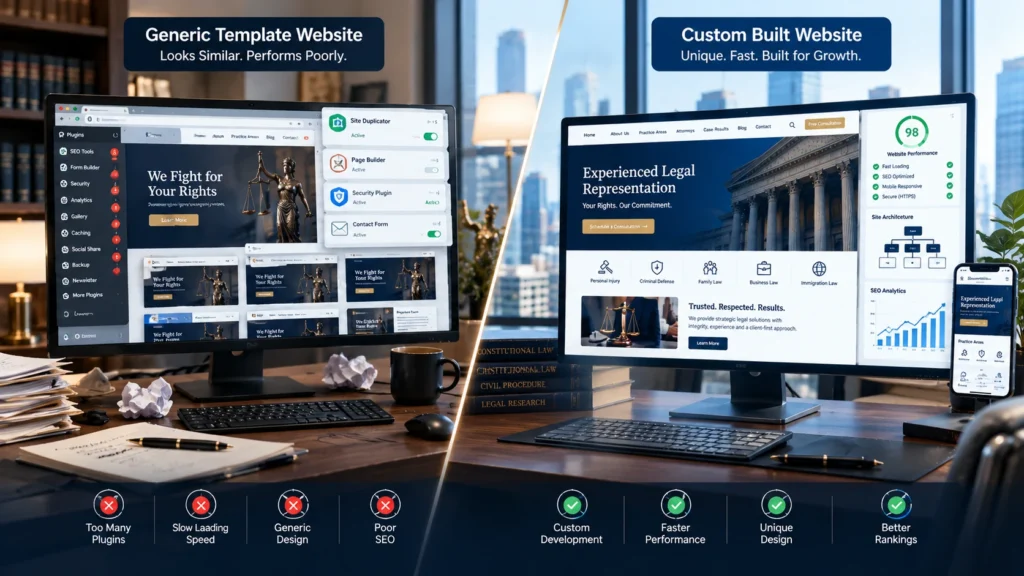
Template vs. Custom Build: What Actually Changes
| Template/Page-Builder Site | Custom-Built Site | |
| Typical load time | 3–6 seconds | Under 2.5 seconds |
| ADA/WCAG review | Rarely done | Built in from the start |
| Design uniqueness | Shared with thousands of sites | Unique to the firm |
| Ongoing maintenance | Plugin-dependent, more breakage | Leaner stack, fewer moving parts |
| Typical cost range | $1,500–$5,000 | $6,000–$20,000+ |
Page builders like Elementor aren’t the enemy. They’re fine for a solo practitioner’s first site. The problem shows up as a firm scales , the plugin stack bloats, load times slow, and nobody on staff can say which of the twelve installed plugins is actually load-bearing.
Should a Firm Build In-House or Hire an Agency?
A marketing coordinator with real WordPress experience can handle basic maintenance in-house, no urgency required. But for an actual build a new site, a migration, or a redesign meant to carry SEO weight , an agency that already knows legal marketing moves faster and skips the compliance blind spots below entirely. The honest trade-off: agency work costs more upfront, but a bad in-house build almost always costs more to fix later than it would have cost to do right the first time.
The Compliance Side Generic Developers Skip
This is where law firm sites differ most from every other WordPress build. Attorney advertising is regulated at the state bar level testimonials, results language, and disclaimer placement all carry rules a generic developer has no reason to know exist. Accessibility is a separate, equally real exposure: the ADA doesn’t spell out precise technical web standards, but courts and the Department of Justice have consistently pointed to WCAG as the working benchmark for compliance, and law firm sites are a frequent target for ADA demand letters specifically because opposing counsel knows exactly what to look for.
A legal SEO, GEO, and AEO foundation and an accessible build aren’t separate projects. They need to happen in the same build, not bolted on afterward.

If a firm’s current site was built by a generalist who’s never dealt with a bar complaint over a testimonials page, that’s worth auditing before anything else gets built on top of it.
→ See how RankFX approaches compliance-aware legal web development
Speed, Core Web Vitals, and Why They Actually Matter Here
Page speed isn’t a vanity metric. Google’s guidance on helpful, people-first content is explicit that pages should be built primarily for people, not to manipulate rankings and a slow, bloated site built purely to “hit keywords” fails that test before it fails anything technical. For a law firm specifically, slow load times compound with high-intent traffic: someone searching after an accident or an arrest isn’t going to wait five seconds for a homepage to render. They’ll call the next result instead.
Maintenance, Security, and the Real Cost Over Time
A WordPress build isn’t a one-time expense. Plugins need updates, themes need patching, and an unmaintained site is a security liability. Law firm sites get targeted for malware injection specifically because a compromised legal site can quietly harvest visitor data for months before anyone notices , client names, contact details, case-related form submissions. Budget for a maintenance retainer, not just a launch fee.
Once the technical foundation is solid, the next bottleneck is usually the writing on top of it , see legal content writing for how that piece fits in.
What a Legal WordPress Build Should Show in Case Studies
When reviewing an agency’s past work, look past the screenshots. Ask about load time before and after, whether the previous site ever had an ADA complaint on file, and how practice-area pages were structured for search , not just how the homepage looks. A firm’s attorney website design work says more in its technical decisions than in its color palette.
One honest limitation: none of this guarantees rankings. A well-built site removes technical obstacles to ranking , it doesn’t replace the content, backlinks, and local signals that actually drive visibility. Anyone promising a WordPress rebuild alone will fix a firm’s search traffic is skipping a step.

FAQ
How long does a law firm WordPress build take?
Typically 4–8 weeks for a full custom build, depending on the number of practice-area pages and whether content is being written alongside the build. Template sites move faster but usually need rework later.
Is Elementor good enough for a law firm site?
Workable for a small, low-traffic site. Heavier page builders tend to slow load times as more pages and plugins get added a real constraint once a firm starts publishing practice-area content and blog posts regularly.
Does a WordPress site need to be ADA compliant?
Yes, in practice. There’s no single federal technical standard, but courts and demand letters overwhelmingly reference WCAG as the working benchmark, and law firm sites are a common target.
What does a custom WordPress build cost for a law firm?
Most custom builds run $6,000–$20,000, depending on page count, whether content is included, and how much design customization is involved. Template builds cost less upfront but often cost more long-term through maintenance and rework.
Should we migrate an old site or rebuild from scratch?
If the old site has indexed pages with backlinks and rankings, migration with careful redirects usually beats a full rebuild , losing that equity is one of the most common self-inflicted SEO mistakes in a redesign.
Getting the technical foundation right is what makes everything built on top of it content, local SEO, case study pages , actually work. If a firm’s current site is slowing that down, RankFX’s website design and development work is built specifically for law firms, not adapted from a generic template.