
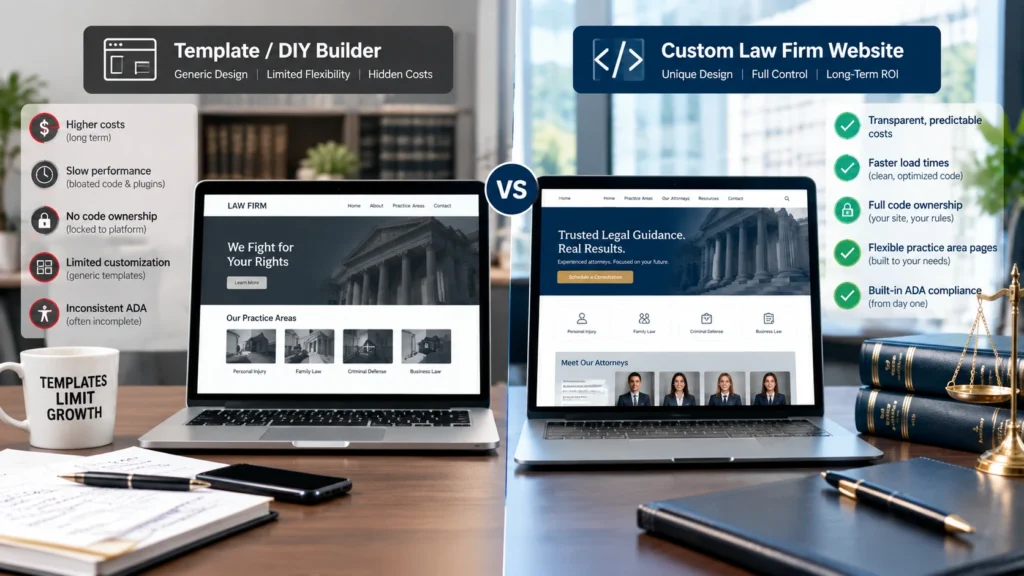
A custom law firm website is built on original code and design specific to one firm, rather than a shared theme or drag-and-drop template, and it typically costs $8,000–$25,000+ with a 6–12 week build. The real difference isn’t visual polish; it’s ownership of the underlying structure, which affects page speed, ADA accessibility, and how easily the site can support SEO work later.
Template vs. Custom: What You’re Actually Comparing
| Template / DIY Builder | Custom Build | |
| Typical cost | $500–$3,000 | $8,000–$25,000+ |
| Build time | 1–3 weeks | 6–12 weeks |
| Code ownership | Locked to platform | Owned by firm |
| Practice-area page flexibility | Limited by theme | Built to spec |
| ADA remediation | Often bolted on, incomplete | Built into the build |
This isn’t a knock on every template , some solo practitioners genuinely don’t need a $15,000 build. But once a firm has more than two or three attorneys, multiple practice areas, or a marketing budget tied to measurable case intake, the limitations of a shared theme start showing up as real cost: slow pages, thin practice-area content the theme can’t accommodate well, and a redesign every time the platform changes its structure.
Why Templates Break Down Specifically for Law Firms
Most website builders were designed for restaurants and small retailers, not for sites that need to hold up under bar advertising rules, YMYL scrutiny from Google, and dozens of near-duplicate practice-area pages without tripping thin-content flags. We’ve written before about what actually separates a functional attorney site from a decorative one; the short version is that most template failures aren’t aesthetic. They’re structural: bloated plugin stacks slowing load times, page builders that can’t cleanly separate practice-area content from location content, and themes that treat an “About” page and a “Practice Areas” page as interchangeable when they need very different information architecture.
A common pattern we see: a three-attorney firm with five practice areas built on a template ends up with one generic “Practice Areas” page listing all five in a bulleted list, because the theme has no template for individual practice-area pages with unique intake language, local relevance, and FAQ schema. That’s not a design failure , it’s a structural ceiling the platform was never built to clear.
Custom vs. In-House: Who Should Actually Build This
For most firms under 15 attorneys, hiring an agency for a custom build costs less over three years than hiring even a part-time in-house developer, once salary, benefits, and the learning curve of legal-specific compliance are factored in. In-house makes more sense when a firm is large enough to need constant content updates, has its own marketing department already, or wants direct control over every deployment. Everyone else is usually paying for a full-time skill set they need in bursts , the build, then quarterly updates , not daily.
The ADA Problem Nobody Mentions Until Someone Gets Sued
Law firm websites are disproportionately targeted in ADA web accessibility demand letters, partly because plaintiffs’ firms know exactly what to look for in a legal industry site. The ADA’s own guidance on website accessibility doesn’t mandate a specific technical standard, which is precisely why so many DIY builds get this wrong: “looks accessible” and “meets WCAG contrast and alt-text requirements” are not the same thing, and a theme built for a bakery was never tested against either. Custom builds can bake alt-text discipline, keyboard navigation, and contrast ratios into the design from the first wireframe instead of patching them in after a demand letter arrives.
If accessibility risk, page speed, or an outdated site are already on your mind, that’s usually the moment to get a second opinion rather than wait for the next redesign cycle , our team can walk through what a build would actually look like for your firm, no pitch deck required.
How the Website Ties Into Map Pack Rankings
A site’s technical foundation feeds directly into local visibility, not just organic search. Page speed, schema markup, and consistent NAP (name, address, phone) data across the site all factor into map pack ranking signals a slow, template-bound site with inconsistent contact info across pages is quietly working against local rankings even when the content itself is fine. Firms often treat “the website” and “GBP optimization” as two separate line items on an invoice, when in practice a poorly built site undermines the local SEO work sitting right next to it.
Case Studies: What to Actually Ask For
Be skeptical of any agency showing a “300% traffic increase” case study without a timeframe, a starting baseline, or an explanation of what else changed during that period new content, a Google algorithm update, seasonal demand for that practice area. A legitimate case study names the starting conditions and is honest about what it can’t isolate as cause. We don’t publish fabricated results, and we’d rather walk a firm through our actual process on a call than hand over a slide with numbers that can’t be verified.
Reviews: What They Actually Tell You
Read reviews for pattern, not tone. One complaint about slow communication means little; three separate reviews describing the same missed deadline or scope surprise is a real signal. Also worth checking: whether the reviews mention the agency’s work specifically for law firms, since general web design experience doesn’t automatically transfer to bar-compliant advertising language or YMYL content standards.
Site Speed and Why It’s Not Just a Technical Detail
Google has been explicit that page experience, including load speed, factors into ranking alongside content quality , not as a replacement for good content, but as a real input. A well-written practice-area page that takes six seconds to load on mobile loses visitors before they read a sentence of it, and that bounce behavior itself becomes a negative signal over time. Custom builds generally outperform template sites here simply because there’s less unnecessary code running in the background.

The Design Still Has to Be Filled With Real Content
A custom design is a shell. What actually earns rankings and trust is what goes inside it , and that’s where a lot of custom builds quietly underdeliver, because the design team and the content team are often separate vendors who never talk to each other. Practice-area pages that are copy-pasted from a template with the city name swapped in look custom but read exactly like a template, which defeats a large part of the investment.
What This Realistically Costs
Expect $8,000–$15,000 for a straightforward multi-practice-area firm site, and $15,000–$25,000+ for larger firms needing custom functionality like intake forms tied to a CRM, multi-office location pages, or attorney bio systems that pull from a shared database. Timelines run 6–12 weeks depending on how quickly the firm can turn around content approvals , the single biggest delay on nearly every project isn’t the build itself, it’s waiting on sign-off. Results from the site, in terms of rankings and lead volume, typically take another 2–4 months to show up after launch, and that’s an honest limitation worth stating: a new site alone doesn’t move rankings overnight, and no agency can promise otherwise.

If your current site is slow, hard to update, or wasn’t built with a law firm’s practice-area and compliance needs in mind, see what a custom build looks like.
FAQ
How much does custom law firm website design cost?
Most custom builds for law firms run $8,000–$25,000+, depending on the number of practice areas, custom functionality, and whether multi-office pages are needed. A single-office, 3–4 practice-area firm typically lands in the lower half of that range; firms adding CRM-connected intake forms or multi-office location pages push toward the top. Template sites cost far less but come with real structural trade-offs.
How long does a custom website build take?
Typically 6–12 weeks. The build itself is rarely the bottleneck ,content approval and revision rounds usually take longer than the design and development work. Firms that assign one decision-maker to sign off on content (instead of routing it through every partner) tend to finish closer to the 6-week end.
Is custom design worth it over a template for a solo practitioner?
Not always. A solo attorney with one practice area and a limited budget can often start with a well-configured template and move to custom later as the firm grows. The point where it usually stops making sense is somewhere around a second practice area or a second attorney , that’s when a shared theme starts constraining the site more than it’s saving money.
What’s the real difference between custom and in-house website management?
Cost, mostly, once you account for salary, benefits, and ramp-up time. Agencies make sense for firms that need a burst of specialized skill for the build and periodic updates after; in-house makes more sense once a firm is large enough to need daily content changes or already runs its own marketing department.
Do custom websites rank better than template sites?
Not automatically , rankings depend on content, links, and technical SEO regardless of platform. But custom builds remove common technical drags (speed, code bloat, accessibility gaps) that make good SEO work harder to execute. A custom site with weak content will still be outranked by a template site with strong content; the platform is a foundation, not a ranking factor on its own.
Should I search “custom law firm website design near me”?
Location matters less here than it does for, say, a plumber , most legal marketing agencies work remotely, and the “near me” instinct is really about wanting someone who understands the local bar and market, not physical proximity. That’s a different search intent, and worth its own piece rather than folding it into this one.