
A legal website design agency should do more than make a law firm’s site look sharp, it needs to load fast, meet ADA accessibility standards, stay inside state bar advertising rules, and turn visitors into booked consultations. General web design agencies rarely account for all four at once, which is where most law firm redesigns quietly underperform.
Most firms hire a designer, get a site that looks better than the old one, and see almost no change in call volume six months later. That’s usually not a design problem , it’s a structure problem. Here’s what actually separates a site that converts from one that just looks nice:
- Practice-area pages built around the client’s actual question, not a generic “Practice Areas” list
- Accessibility and speed baked in from the build, not patched on after a complaint or a slow PageSpeed score
- Conversion paths tuned to legal decision-making , click-to-call on mobile, short intake forms, no dead-end pages
What a Legal Website Design Agency Actually Builds
A legal website design agency’s job isn’t the homepage , it’s the architecture underneath it. That means practice-area pages written for how someone actually searches (“do I have a case if the other driver had no insurance” beats a page that just says “Personal Injury”), attorney bio pages with real credentials and bar admissions, and a site structure that gives Google and AI answer engines a clean map of what the firm does and where.

Legal SEO, GEO, and AEO work has to sit underneath the design from day one, not get bolted on after launch , a beautiful site with no crawlable structure or schema markup still won’t show up when someone asks ChatGPT or Google’s AI Overview who handles a specific kind of case in their city.
Why General Web Design Agencies Struggle with Law Firm Sites
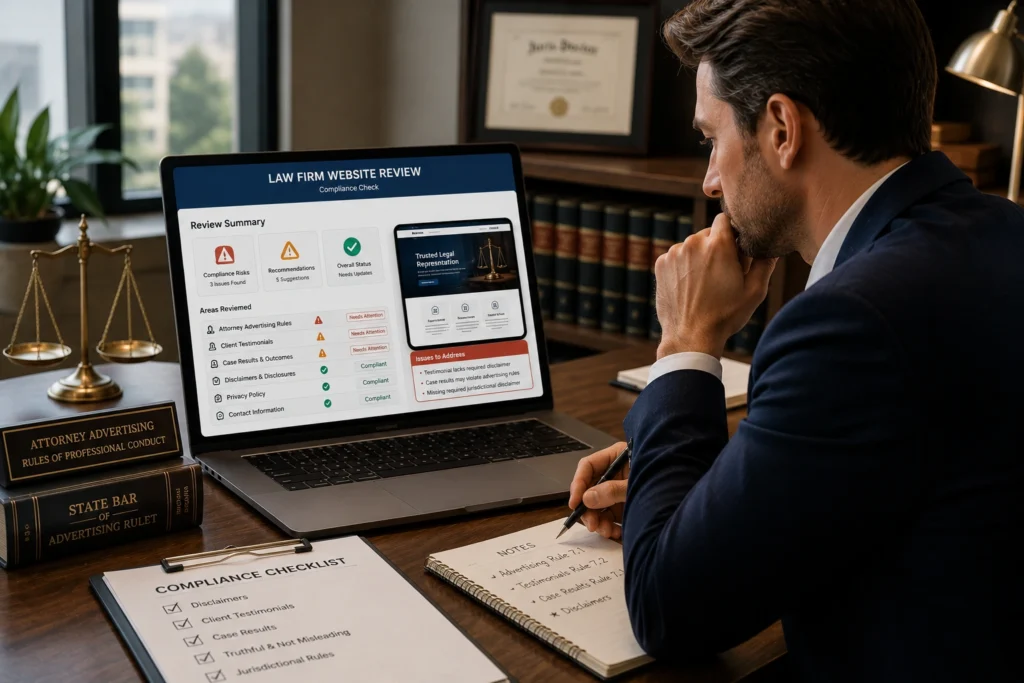
A general agency can build a fast, attractive site and still get a firm in trouble. Attorney advertising isn’t like advertising a restaurant or a plumbing company, claims about outcomes, comparisons with other lawyers, and how testimonials get displayed are all governed by professional conduct rules. Under the American Bar Association’s Model Rule 7.1, a communication about a lawyer’s services is misleading if it creates an unjustified expectation about results, and comparisons with other lawyers have to be factually substantiated before they go on the page.
A designer with no legal-marketing background usually doesn’t know that rule exists, let alone how their state bar interprets it. That’s the gap a legal-only agency is built to close , case result language, testimonial placement, and “years of experience” claims get checked against bar rules before they go live, not after a complaint.
What’s Included in a Typical Legal Website Design Agency Package
Packages vary, but a reasonably complete one usually covers the same core pieces: a mobile-first, ADA-aware build; practice-area and attorney-bio pages written for the firm’s specific jurisdictions (not templated boilerplate swapped between clients); attorney bio and practice-area content written to actually answer what a prospective client is asking; basic technical SEO (schema, sitemap, page speed); and a CMS the firm’s own staff can actually update without calling the agency every time a phone number changes.
What’s often not included, and worth asking about directly: ongoing content after launch, GBP management, and whether “unlimited revisions” has a real cutoff. A site is a starting point, not a finished asset , a firm that treats launch day as the end of the project usually sees rankings flatten within a year.
How Much Do Legal Website Design Agency Packages Cost?
Pricing depends heavily on how many practice areas the site covers, how competitive the target market is, and whether the build includes ongoing SEO or just design and development. There isn’t one honest number that fits every firm, a single-practice-area solo site and a multi-location personal injury firm’s site aren’t priced the same way, and any agency quoting a flat number before seeing your current site and market is guessing.
A few things move the price more than firms expect going in. Migrating years of old blog content and practice-area pages costs more than starting fresh, because someone has to decide what’s worth keeping versus rewriting. Multi-location firms pay more for location-specific pages that need to be genuinely distinct, not the same page duplicated with a different city name swapped in, Google treats that kind of near-duplicate content as a signal the site isn’t putting in real effort, and it tends to hold every page back, not just the copied ones. And a firm that wants full ongoing content and SEO folded into a monthly retainer will naturally pay more upfront than one buying a standalone design-and-build project with no follow-on work.
ADA Compliance: The Risk Most Agencies Underplay
Here’s the detail a lot of general web design agencies miss entirely: law firm websites are a disproportionately common target for ADA web accessibility demand letters and lawsuits, in part because plaintiffs’ firms know exactly how to find an inaccessible site and exactly how the claim works. A site built without alt text, keyboard navigation, or sufficient color contrast isn’t just a UX miss for a law firm specifically , it’s a liability risk that lands squarely inside the firm’s own field of practice.
The Department of Justice’s guidance on web accessibility and the ADA lays out what “accessible” actually means in practice , keyboard navigability, screen-reader compatibility, and sufficient contrast among the core requirements. A legal-only agency builds to that standard by default; it shouldn’t be a line item you have to request.
If your current site was built years ago and nobody’s audited it against ADA guidance since, that’s worth checking before a redesign, not after a demand letter shows up. See what a free visibility and accessibility audit turns up , no obligation attached.
Mobile-First Design and How Legal Clients Actually Browse
Most legal searches now happen on a phone, often at a moment of real urgency , after an accident, after a termination, in the middle of a custody dispute. That changes what “good design” means: a desktop-first site with a beautiful hero image and a phone number buried in a footer menu loses people who are ready to call right now. Attorney website design built for how legal clients actually browse puts click-to-call, a short intake form, and the firm’s core value proposition above the fold on mobile , not just on desktop, where fewer of these visits actually happen.
Site Speed and Core Web Vitals: Why Slow Pages Lose Cases
Speed isn’t a vanity metric , it’s a ranking factor and a conversion factor at the same time. Google measures real-world loading, responsiveness, and visual stability through what it calls Core Web Vitals, and a firm’s page needs to load its largest content within roughly 2.5 seconds to be considered “good” by that standard. Heavy page-builder plugins, oversized images, and bloated theme code are common culprits on older WordPress law firm sites, and they quietly cost both rankings and the visitor who gives up waiting and clicks a competitor instead.
What to Ask Before You Sign With a Legal Website Design Agency

“Reviews” and “case studies” are reasonable things to ask an agency for , just be specific about what you’re asking to see. A results screenshot with no context proves very little; ask instead for a live example of a site the agency built for a firm in a comparable practice area, how long that firm has been a client, and what changed in the first 90 days versus what’s still in progress. Any agency that’s cagey about showing an actual site, or that promises a ranking guarantee, is a red flag regardless of how the rest of the pitch sounds , no one controls Google’s algorithm, and practice-area content that ranks in a competitive market takes real, sustained work, not a one-time redesign.
FAQ
Does a redesign guarantee more calls or better rankings?
No , and any agency claiming otherwise is a warning sign, not a selling point. A well-built site removes friction and gives Google and AI tools something worth ranking, but results depend on the market, the content published after launch, and ongoing SEO work.
How long does a legal website redesign take?
Most law firm redesigns run 6 to 12 weeks depending on how many practice-area pages need writing and how much content migration is involved from the old site.
Do I need a new website or just an SEO campaign?
If the current site is slow, not mobile-friendly, or hasn’t been touched in several years, design usually needs to come first , SEO work built on a weak site foundation underperforms regardless of how good the content is.
Will a new website fix an ADA accessibility complaint I’ve already received?
A rebuilt, accessible site addresses the underlying issue going forward, but an active demand letter or complaint is a legal matter , that’s a conversation for the firm’s own counsel, not a marketing agency.
Can I keep my current CMS or do I have to move to WordPress? Most agencies can work within an existing CMS, though WordPress is the most common choice for law firm sites because of its plugin ecosystem and the number of developers familiar with it.