
GBP optimization for law firms means configuring and maintaining your Google Business Profile , the free listing that controls how your firm appears on Google Maps and in local search , so it accurately reflects your practice area, location, and activity. The core work covers category selection, complete service and attorney information, consistent NAP data, and a steady flow of recent reviews. Done well, it’s the single biggest lever a firm has over map pack visibility.
If you’ve searched for this, you already know the map pack , the block of three listings above organic results , gets the majority of clicks for “attorney near me” style searches. What most firms don’t know is that a fully built-out website often has less influence on map pack placement than a properly configured Google Business Profile. That’s a hard pill for firms that just spent five figures on a redesign, but it’s how the algorithm actually weighs local intent.
This matters more now than it did two years ago. AI-driven search tools are starting to pull local business information directly from Google Business Profile data when answering “find me a [practice area] lawyer near me” style prompts, which means an incomplete or stale profile doesn’t just hurt map pack rank , it can leave your firm out of AI-generated answers entirely.
Below is what actually moves the needle, in the order it typically matters, plus the honest limitations nobody puts in the pitch deck.
What Determines Map Pack Ranking for a Law Firm
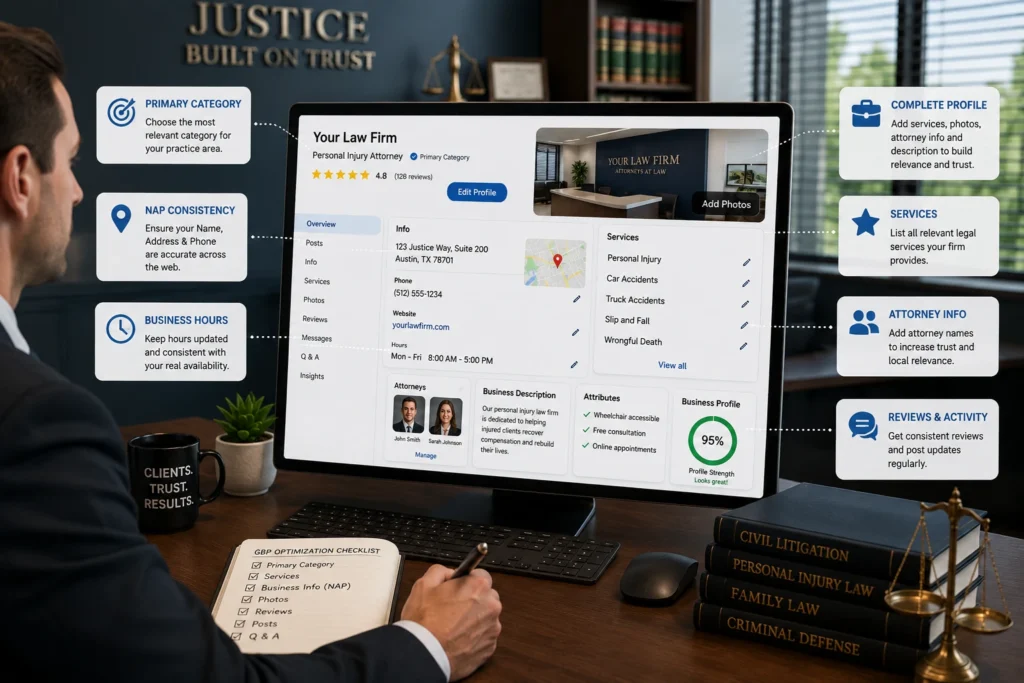
Google has been consistent about this for years: local pack placement comes down to relevance, distance, and prominence. Relevance is how well your profile matches the search a firm categorized as “Personal Injury Attorney” will out-rank a generically categorized “Law Firm” for injury-related searches, even with a weaker website. Distance is the proximity between your office address and the searcher, which you can’t change but can avoid undermining with inconsistent address data. Prominence is the composite signal built from review volume, review recency, citation consistency, and general web presence.
None of these three factors work in isolation. A firm with a perfectly optimized category but three-year-old reviews and no recent photo activity will still lose to a competitor with a slightly less precise category but consistently fresh signals. Prominence, in practice, is the factor most firms neglect because it requires ongoing maintenance rather than a one-time setup.
Getting Your Category and Core Information Right
Your primary category is the single highest-impact setting on the entire profile. Google’s own Business Profile Help documentation confirms that the categories you select directly affect your local ranking and determine which searches connect your business to potential customers , which is why choosing “Divorce Lawyer” or “Personal Injury Attorney” instead of a vague “Law Firm” or “Legal Services” category makes a measurable difference for practice-specific searches.
Beyond the primary category, secondary categories should reflect genuine additional services, not an attempt to rank for every adjacent search term. A firm that stacks ten loosely related categories dilutes the relevance signal rather than strengthening it. Service area settings, attorney names listed as individual profiles where appropriate, business hours that match actual availability, and a complete “from the business” description using your real practice areas all feed the same relevance signal.
Name, address, and phone (NAP) consistency across your website, your profile, and every legal directory , Avvo, FindLaw, Justia, Martindale , matters more than most firms realize. A suite number that’s correct on your website but outdated on three directories creates the kind of inconsistency that quietly suppresses local ranking without any obvious symptom pointing to the cause.
Reviews: Volume Matters Less Than Recency
Review strategy is where most law firms either stall or actively hurt themselves. Google’s guidance on getting more reviews is direct: businesses should remind clients to leave reviews and can share a request link, but offering any incentive , a discount, a gift, even removal of a negative review , in exchange for a review is explicitly prohibited.
For law firms specifically, this restriction overlaps with state bar advertising rules, which adds a second layer most other industries don’t have to deal with (more on that below). The practical approach that holds up under both sets of rules is a consistent, unincentivized request built into your intake and case-closing process , a personal message or email sent within a day or two of a positive interaction, not a bulk request campaign months later.

A firm with 25 reviews collected steadily over the past six months typically outperforms a firm with 80 reviews collected over four years, because recency signals an actively operating, currently engaged business. If your review count has been flat for a year, that’s a stronger predictor of map pack stagnation than almost any other single metric on your profile.
GBP Posts, Photos, and Ongoing Activity
A profile that’s set up once and never touched again behaves differently from one with regular activity. Google Business Profile Posts , short updates about a new practice area, a case type you handle, or a relevant legal update , signal an active business and give you a low-effort way to reinforce keywords tied to specific services. Photos matter similarly: profiles with recent, real photos of the office, team, and signage tend to perform better than profiles using a single stock image uploaded at setup.
None of this replaces the underlying relevance and distance factors, but it feeds the prominence signal continuously rather than as a one-time input, which is the piece most firms let lapse after the initial setup is done.
State Bar Advertising Rules and Your Google Business Profile
Legal marketing carries a compliance layer that a restaurant or plumber never has to think about. The ABA’s Model Rule 7.2 on communications concerning a lawyer’s services governs how lawyers communicate about their services across any media, restricts compensating anyone for recommending a lawyer, and requires clear disclosure in certain circumstances , and individual state bars frequently add stricter requirements on top of the model rule, particularly around specialization claims.
This is directly relevant to your profile description and posts. Claiming to be a “specialist” in a practice area without the certification required under your state bar’s rules, or listing case outcomes and win rates in your GBP description, isn’t just a compliance risk , it’s the kind of unverifiable claim that a skeptical potential client, or a search engine’s quality evaluation, treats as a red flag rather than a credibility signal. Sticking to accurate, checkable information about what you handle and where does more for both compliance and trust than any superlative would.
Website vs. GBP: What Each Actually Controls
It’s worth being precise about the division of labor here, because firms often invest disproportionately in one at the expense of the other. Your website drives organic rankings for non-local or research-stage searches and is where map pack traffic converts once someone clicks through. Your Google Business Profile controls whether you show up in the map pack in the first place. A firm can have a technically excellent website and still be invisible in local search because the profile was never properly categorized or maintained , and the reverse is just as common.
If your site’s technical foundation, schema markup, or page structure is the gap rather than your profile, RankFX Global’s work on law firm website design covers what that side of the equation actually requires.
What a Realistic Timeline Looks Like
Google Business Profile changes tend to show measurable movement faster than website-driven organic rankings, typically within four to eight weeks for category corrections and consistency fixes, since these are direct, structural signals rather than content that needs to be crawled, indexed, and evaluated over time. Review-driven prominence gains build more gradually , usually over two to four months of consistent, unincentivized review generation , because Google weighs the pattern of activity, not a single burst.
Competitive practice areas and major metros stretch this timeline. A solo estate planning attorney in a mid-sized city will typically see profile-driven movement faster than a personal injury firm competing in a saturated market where every competitor already runs an active review program. Nobody controls Google’s algorithm, and any timeline promise more specific than a realistic range should be treated with the same skepticism you’d apply to a guaranteed case outcome.
If you’re not sure whether your profile’s underlying issue is category selection, review velocity, citation inconsistency, or something else entirely, a direct audit is more useful than guessing. You can see RankFX Global’s approach to legal SEO and Google Business Profile work.

If it’s easier to talk through your specific practice area and market, get in touch directly and start with what a realistic starting point looks like for your firm.
FAQs
How much does GBP optimization for law firms typically cost ?
Costs vary by scope and market, but ongoing Google Business Profile management for a law firm typically runs a few hundred to a few thousand dollars per month depending on whether it’s bundled with broader local SEO work or handled as a standalone service.
How long does it take to see results from GBP optimization ?
Structural fixes like category corrections and NAP consistency can show movement within four to eight weeks. Review-driven prominence gains typically build over two to four months of consistent activity.
Can offering a discount for a review get my firm’s profile penalized ?
Yes. Google’s policies explicitly prohibit offering any incentive, including discounts or removal of negative reviews, in exchange for a review, and this can result in review removal or profile restrictions.
Does my firm need a separate Google Business Profile for each attorney ?
Generally no , individual attorney profiles are typically used for solo practitioners or when an attorney operates a distinct practice; multi-attorney firms usually consolidate under one firm-level profile with attorney names listed in the description or as staff information.
Is it worth optimizing GBP if my website already ranks well organically ?
Yes, because organic website rankings and map pack placement are governed by different signal sets , a firm can rank well organically for research-stage searches and still be absent from the map pack that captures higher-intent local searches.

4 Responses