
“Local SEO for law firms near me” isn’t one ranking factor , it’s really two separate systems (organic local results and the Google Map Pack) that respond to different signals, including proximity to the searcher, Google Business Profile completeness, review volume and recency, and citation consistency. Firms that treat it as a single checklist usually optimize the wrong half.
If you’ve searched “personal injury lawyer near me” from your own office and seen a competitor three miles away outrank you, you’ve already felt the gap between organic rankings and map pack rankings. They’re graded on different curves, and most of what gets pitched as “local SEO” only touches one of them.
Organic Rankings vs. the Map Pack: Two Different Games
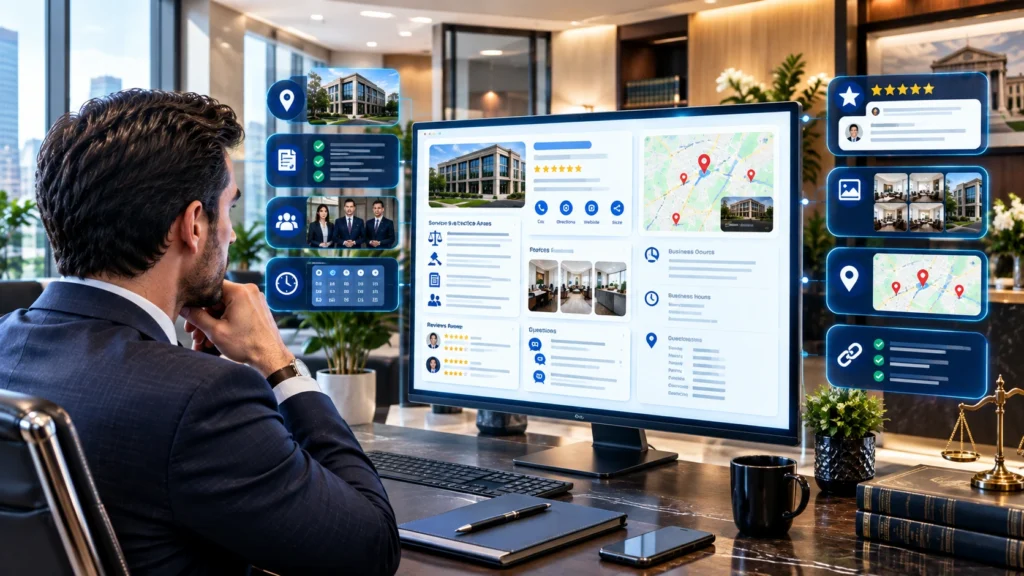
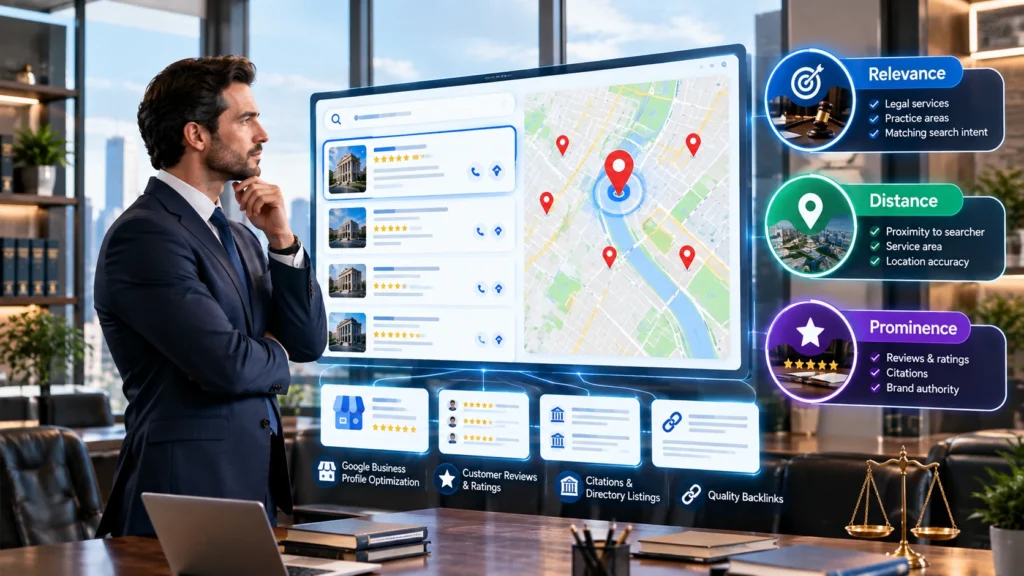
Your website’s organic position in Google is driven by the usual mix , content depth, backlinks, technical health, site authority. The Map Pack (the three-listing block with the mini-map) runs on a narrower set of inputs: proximity, relevance, and prominence, per Google’s own guidance on local ranking. A firm can rank #1 organically for “divorce attorney [city]” and still miss the Map Pack entirely if its Google Business Profile (GBP) is thin, under-reviewed, or geographically disadvantaged relative to the searcher.
This matters because most “near me” search traffic clicks into the Map Pack first. If your broader legal SEO strategy is entirely content- and backlink-driven, you’re winning half a fight you didn’t know you were only fighting half of.
What is proximity, relevance, and prominence, in plain terms?
Proximity is how close your listed address is to the person searching , the one factor you genuinely cannot game. Relevance is how well your GBP category, services, and description match the query. Prominence is a composite of review count, review quality, citation consistency, and general online visibility , the part where sustained work actually moves the needle.
Google Business Profile: The Foundation Nobody Finishes
Most law firm GBPs we audit are maybe 60% complete. Primary category set, sure. Secondary categories, hours, attorneys listed as team members, services itemized by practice area, Q&A section populated, photos beyond a stock logo , that last stretch is where firms stop, and it’s also where prominence signals live.
A detail we flag on almost every audit: firms using a shared executive suite or virtual office address as their GBP location. Google has gotten aggressive about suspending profiles tied to addresses with dozens of unrelated businesses registered at the same suite number, especially in legal and financial services categories. If your firm operates from a coworking space or a “registered agent” address rather than a real staffed office, that’s a suspension risk before it’s ever a ranking opportunity , worth checking before you invest in anything else on this list.
| Signal | Fast to fix | Takes months |
| GBP completeness (categories, services, hours, photos) | Yes | — |
| NAP consistency across directories | Mostly | Cleanup can drag |
| Review volume and velocity | — | Yes |
| Domain authority / backlinks | — | Yes |
| Proximity to searcher | Never (fixed) | — |
Reviews Move the Needle , But Not However You Get Them
Review count and recency are prominence signals Google weighs directly, and they’re also the piece bar rules touch. Soliciting reviews is fine; scripting testimonial language for attorneys, offering anything of value in exchange for a review, or posting reviews attributed to non-clients runs into advertising and solicitation rules most state bars enforce, and ABA Model Rule 7.2 on lawyer advertising is the baseline most state versions build from. A generic “ask for reviews” tactic that works fine for a plumber can create real compliance exposure for a firm , this is one of the few places where legal-specific knowledge changes the tactic, not just the copy.
If your firm has had a GBP suspended, or reviews flagged and removed in bulk, that’s usually the moment to get a specialist involved rather than resubmit and hope , our GBP optimization work for law firms starts most engagements with exactly this kind of cleanup before touching anything else.
Citations and NAP Consistency
Name, address, and phone number (NAP) need to match, character for character, across every directory that lists your firm , Avvo, Justia, FindLaw, state bar directories, Yelp, Apple Maps. A suite number dropped in one listing and present in another is enough to create ambiguity that dilutes the consistency signal. This is unglamorous work and it’s also one of the few local SEO tasks with a genuinely fixed endpoint , you can finish it, unlike content or reviews, which are ongoing.
The AI Local Pack Is Already Changing the Picture
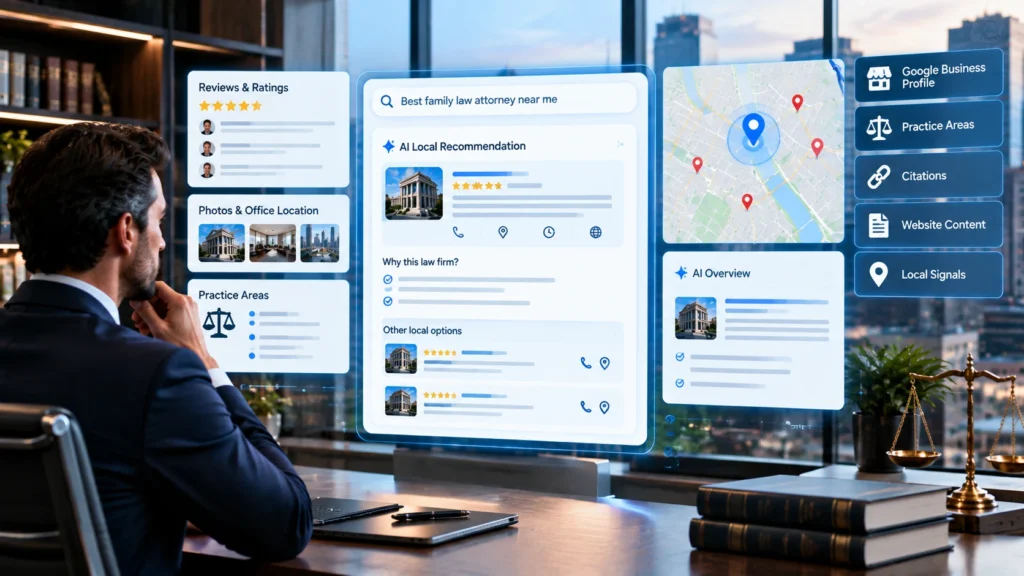
Google’s AI-generated local summaries (surfaced in AI Overviews and increasingly in Gemini-powered search results) pull from a narrower slice of signals than the traditional Map Pack, and one pattern is checkable yourself: run the same “best [practice area] attorney near me” query on two different days and read how each firm gets characterized. The summary language tracks the two or three most recent Google-native reviews far more closely than the aggregate star rating , a firm sitting at 4.8 stars but with one lukewarm review from last week can get described more cautiously than a competitor at 4.5 with glowing recent commentary. Star average still matters for the traditional Map Pack; it’s the AI summary layer that’s newly sensitive to recency over volume. Photos matter too, in a similar way , profiles built around images that read as an actual staffed office (signage, a real reception area, attorneys at their desks) get described with more confidence than ones leaning on stock photography or a logo tile. Most firms haven’t adjusted for either yet, which is currently more opportunity than most competitors realize.
Do I Need Separate Profiles for Multiple Attorneys or Offices?
Generally, one GBP per physical, staffed location , not one per attorney at a shared address, which Google treats as a spam pattern. A firm with three real offices needs three profiles; a firm with three named partners at one office needs one. Getting this structure wrong is a common reason multi-attorney firms see profiles suppressed rather than ranked.
How Content Fits Into Local SEO
Local SEO isn’t purely a GBP exercise , practice area pages that name the cities and counties you actually serve give Google (and now AI answer engines) the geographic relevance signal that a generic “our practice areas” page doesn’t. This overlaps with content built specifically for local relevance rather than treated as an afterthought bolted onto the GBP work.
None of this should imply guaranteed results , local rankings fluctuate with competitor activity, algorithm updates, and market density in ways no agency, including ours, controls. A solo practice in a mid-size market might see map pack movement in 8–10 weeks; a firm competing in a metro area against 40 other personal injury practices should expect a longer runway, closer to 4–6 months for meaningful movement. Anyone promising a fixed timeline regardless of market is skipping this part on purpose.
Ready to see where your GBP currently stands against nearby competitors? Our local map pack audit starts with exactly that comparison before recommending anything.
FAQ
Does “near me” actually need to appear in my website content?
No , Google infers “near me” intent from the searcher’s location automatically, so the phrase itself doesn’t need to be on the page. What matters is that your GBP and site clearly state the specific cities, counties, or neighborhoods you serve.
How long does local SEO take for a law firm?
Most firms see initial Map Pack movement within 8–12 weeks of GBP and citation cleanup, with more competitive practice areas or metro markets taking 4–6 months for durable results.
Can I run local SEO myself, or does it require an agency?
GBP setup and citation cleanup are doable in-house with a few focused hours; ongoing review generation, competitive tracking, and content built around local relevance are where most solo attorneys and small marketing teams run out of bandwidth.
Does local SEO help with practice areas that aren’t location-dependent, like appellate work?
Less directly , the Map Pack is inherently local, so practice areas without a “near me” search pattern get more value from traditional organic and content-driven SEO than from GBP work.
Is it against bar rules to ask clients for Google reviews?
Asking is generally fine; scripting attorney testimonial language, offering anything in exchange for a review, or posting reviews from non-clients runs into most state bar advertising rules , check your specific state’s version of Model Rule 7.2.