
Attorney local map pack SEO is the work of getting a law firm into the three-listing Google Maps block that appears above organic results for searches like “divorce lawyer near me.” It runs on a different algorithm than regular SEO, relevance, distance, and prominence, driven mainly by your Google Business Profile , and it can move faster than organic rankings, often within 60 to 90 days, though highly competitive practice areas take longer.
What Is Attorney Local Map Pack SEO?
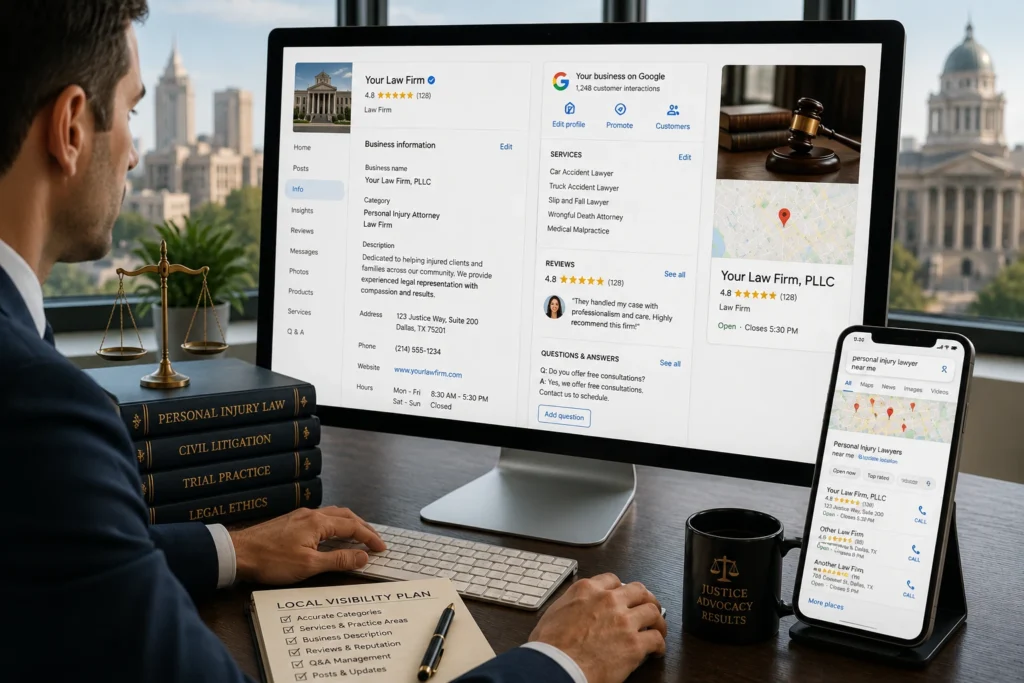
The map pack (also called the local pack or 3-pack) is the block of three business listings with a map that Google shows above the regular blue links for local searches. For a lawyer, that means it’s the first thing a prospective client sees before ever reaching an organic result and on mobile, often the only thing they see before calling.
Ranking here depends on three signals Google has stated directly:
| Signal | What it measures | Can you influence it? |
| Relevance | How well your profile matches the search | Yes , categories, services, description |
| Distance | How close you are to the searcher | Barely , mostly fixed by office location |
| Prominence | How well-known and trusted you appear | Yes , reviews, citations, backlinks |
Distance is the one lever nobody controls. That’s actually good news: it means two of the three factors that decide your map pack visibility are things a firm can genuinely change, which is more than can be said for most of organic SEO. For the fuller picture of how this local layer connects to everything else in a firm’s search presence, our breakdown of SEO for lawyers covers where it fits.
Why the Map Pack Matters More for Lawyers Than Most Businesses
Legal searches skew local and urgent in a way few other industries do. Someone searching “DUI lawyer near me” at midnight isn’t comparison shopping across ten tabs. They’re picking from the three names Google shows them and calling the first one that looks legitimate.
That urgency cuts a specific way for law firms: a firm can have excellent organic content, strong domain authority, and still lose every one of these searches because its Google Business Profile is thin or its reviews are stale. The map pack doesn’t care how good your practice-area pages are if your profile hasn’t been touched since 2023.
The Three Signals That Actually Decide Who Gets In
Google’s own guidance on improving local ranking confirms that results are based primarily on relevance, distance, and prominence, and that complete, accurate business information is what drives the first two.
Relevance for a law firm means the primary category matches what you actually do “Divorce Lawyer,” not the vaguer “Law Firm,” which flattens you into every legal search and wins none of them specifically. Prominence is where most of the real work lives: review count, review recency, citation consistency across legal directories, and whatever Google can find about your firm elsewhere on the web. A firm with 40 reviews from two years ago is frequently outranked by a firm with 15 reviews, ten of which landed in the last month. Review recency carries more weight in 2026 than raw volume does.
GBP Suspensions Are the Risk Nobody Budgets For
Here’s a specific mechanic that generic local SEO advice rarely mentions: law firm Google Business Profiles get suspended more often than profiles in almost any other industry, and the map pack ranking work above means nothing if the listing itself goes dark.
The usual triggers are a shared virtual office address, a business name with keywords stuffed into it (“Smith Law , Best Divorce Lawyer Chicago”), or a sudden spike in reviews that looks manufactured rather than earned. Once a profile is suspended, it can sit in appeal limbo for weeks, and every day it’s down is a day a competitor absorbs your “near me” traffic.
If a firm has never had its profile checked against exactly these risk factors, that’s the first thing worth fixing before spending another dollar on reviews or citations. GBP optimization built around how law firm profiles specifically get flagged catches this before it becomes a suspension instead of after.
Reviews Move Rankings, But Bar Rules Still Apply
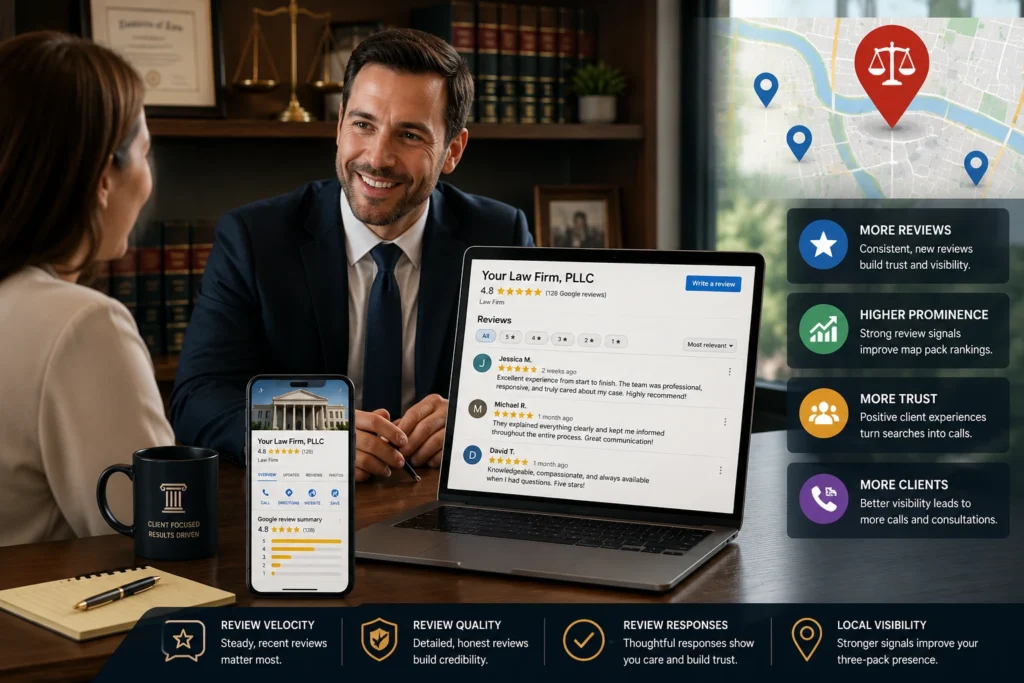
Reviews are the strongest lever a firm actually controls for prominence, and the instinct is to solicit them aggressively , automated text blasts after every closed matter, bulk requests to old client lists. That instinct runs into a real constraint most generalist agencies never mention.
ABA Model Rule 7.2 governs how lawyers can communicate about their services, and its comments specifically address recommendations and endorsements , the same category client testimonials and reviews fall under. A blanket, unfiltered review-solicitation campaign that doesn’t account for confidentiality (a client can’t leave a public review naming case details without risking privilege issues) is the kind of thing that looks fine on a marketing dashboard and creates a real problem for the attorney whose name is on the license.
None of this means don’t pursue reviews. It means the solicitation process needs a filter a generalist agency running the same playbook for a dentist and a divorce attorney usually doesn’t have built in.
What This Actually Costs
Pricing for attorney local map pack SEO varies more by scope than by provider, because “local SEO” can mean a one-time profile cleanup or an ongoing review-and-citation program running for years.
| Scope | Typical monthly range | What’s included |
| Profile audit + one-time fixes | $500–$2,000 (often one-time) | Category correction, NAP cleanup, suspension-risk check |
| Ongoing local SEO retainer | $500–$3,000/month | Review generation systems, citation building, GBP posting cadence |
| Full local + organic package | $1,500–$6,000+/month | Map pack work plus practice-area content and technical SEO |
Multi-office firms and highly competitive metros , think personal injury in a major city , sit at the top of every range, since citation cleanup and review-velocity work scales with each additional location. A solo estate planning attorney in a smaller market usually needs far less to see real movement.
Organic Rankings and the Map Pack Are Two Different Fights
This is the part most firms get backwards: ranking organically and ranking in the map pack are separate systems with separate signals, and doing well at one says almost nothing about the other. A firm can have a page-one organic ranking for “Chicago personal injury lawyer” built on years of content and backlinks, and still be entirely absent from the map pack above it because nobody’s touched the Google Business Profile since it was claimed.
The reverse happens just as often. A firm with a strong, active profile and 150 reviews can dominate the map pack in its immediate neighborhood while sitting on page three organically for the exact same search term city-wide. Chasing one without the other leaves real visibility on the table , the firms that show up in both spots for the same query capture a noticeably larger share of the clicks than firms that only win one.
One Profile or Many? The Multi-Attorney Question
Firms with several attorneys practicing different areas hit a structural decision before any optimization work starts: one firm-wide profile, individual profiles per named attorney, or both. Get this wrong and either named-attorney searches (“John Smith Chicago lawyer”) get buried under the firm-wide listing, or reviews split across multiple profiles that should have been consolidated into one.
This decision also touches location pages directly, a multi-office firm needs a genuine, non-duplicate page for each city it serves, not a template with the city name swapped out, since Google has gotten reliably good at spotting that pattern. Our practice area page writing work runs into this exact issue constantly: a location page that just says “we serve Denver” ranks nowhere near as well as one that actually reads like it was written by someone who knows the city’s courts.
The AI Local Pack Is Already Changing the Rules
Google’s traditional map pack is increasingly joined, sometimes replaced, by an AI-generated local pack that surfaces only two firms with a written summary instead of three listings with a Call button. Instead of ranking on categories and citations alone, this version reads review sentiment (“50 reviews mention ‘compassionate'”) and looks for evidence of a real, staffed office rather than a virtual address, pulling from local media mentions and directory profiles most firms never think to check.
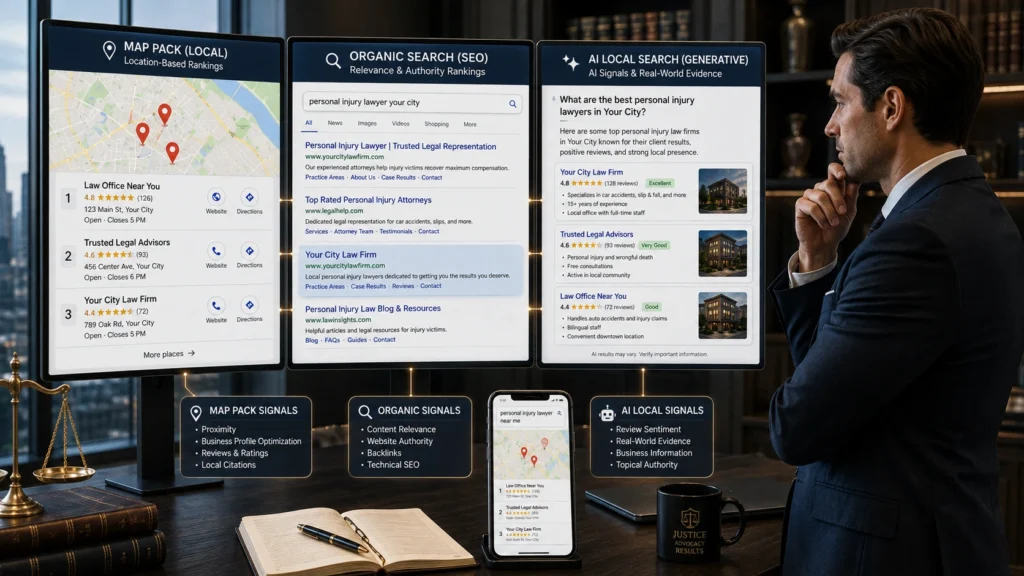
This is a different kind of visibility than a map pack position, and it rewards different signals: structured, credible content about the firm alongside the profile work, not the profile work alone. Legal SEO, GEO, and AEO built for both search modes is the difference between showing up in the version of local search most firms are still optimizing for and the version that’s actually replacing it in some markets.
FAQ
How long does it take to rank in the map pack?
Most firms see initial movement within 60 to 90 days, faster than typical organic timelines, because the local algorithm relies on a smaller, more direct set of signals. Highly competitive practice areas like personal injury in major metros usually take longer, closer to 4 to 6 months for a genuinely dominant position.
How much does attorney local map pack SEO cost?
Most firms land between $500 and $3,000 per month for an ongoing program, with one-time audits and fixes running lower. Multi-location firms and competitive practice areas typically run higher because citation and review work scales with each additional office.
Do reviews actually affect map pack rankings?
Yes , review count, rating, and especially recency are core prominence signals, and Google has said as much directly. A firm earning a steady handful of new reviews each month usually outranks a firm with more total reviews but no recent activity.
Why is my firm ranking organically but not in the map pack?
Organic and local rankings are separate systems with different signals. Strong content and backlinks drive organic position, while an incomplete Google Business Profile, inconsistent citations, or a stale review profile can keep an otherwise strong site out of the map pack entirely.
Can a law firm lose its Google Business Profile?
Yes , suspensions happen to law firms more often than most industries, usually from shared office addresses, keyword-stuffed business names, or review activity that looks manufactured. A suspended profile can stay down for weeks during appeal, which is lost visibility with no easy fix once it happens.
If your firm’s map pack position doesn’t match the work you’ve already put into your website, the gap is usually sitting in the profile, not the content. GBP and local map pack optimization built specifically for how law firm profiles get evaluated starts by finding exactly where that gap is.