You have a website. You have published blog posts. You have read articles about keywords and headings and word counts. And your Google Analytics still shows the same 40 visitors per month, mostly your business partner and someone in a different country who landed on the wrong page.
The problem is not that you are creating content. The problem is that your content has no strategy behind it. Publishing without a plan is the digital equivalent of opening a shop in a city with no signs pointing to it. Google cannot rank what it does not understand. Visitors cannot convert from traffic that never arrives. And your competitors who publish strategically are capturing every client you could have had.
Building a real SEO content strategy to rank and get clients fast is not about writing more. It is about writing the right things, in the right order, targeting the right people, with every piece of content serving a specific purpose in your client acquisition funnel. This article tells you exactly how that works.
Does your current content plan generate client enquiries from Google? Contact RankFX Global for a free content strategy audit — we respond within 24 hours.
Why Most Business Websites Publish Content That Gets Zero Clients
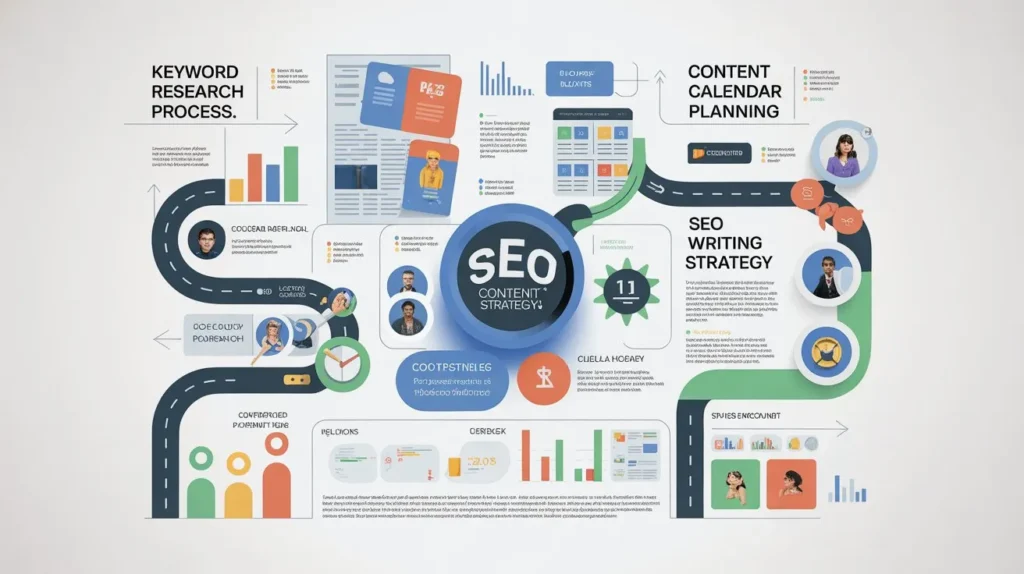
The gap between publishing content and generating clients from that content is larger than most business owners expect. And the reason almost always comes back to the same core problem: the content was created to fill a publishing calendar, not to answer the specific questions real clients search for at the exact moment they are ready to hire someone.
How to create an SEO content strategy for a new website, or an existing one that is not generating leads, starts with a fundamental shift in how you think about what you are writing. Most business websites publish content that answers questions their audience finds interesting. A successful content strategy publishes content that answers questions their audience searches on Google the week before they are ready to buy.
These are not the same questions. And confusing them is why most business blogs generate readers but not clients.
The businesses that generate consistent client enquiries from organic search do not publish more frequently than their competitors. They publish more deliberately. Every article targets a specific search term their ideal client types into Google. Every article leads the reader toward a specific next step. And every article is part of a coherent strategy that builds topical authority, the signal Google uses to decide which websites are genuinely expert in their field.
What I’ve seen consistently across content campaigns is that the first 10 articles a business publishes almost never generate significant traffic. Not because the writing is bad, but because Google needs to see a pattern of topical depth before it rewards a website with consistent page one placement. The businesses that give up at article 8 miss the compounding effect that starts at article 12.
Scenario — Type 5: The Competitor Gap Two accounting firms launched websites within 4 months of each other in Toronto in early 2023. Firm A published 2 blog posts per month based on topics their marketing intern found interesting, “the history of Canadian tax law” and “what is an accountant.” Firm B built a keyword-researched content strategy targeting 18 specific search terms their potential clients used, “small business tax return Toronto cost”, “GST filing deadline Canada 2024”, “how to find a good accountant Scarborough.” At month 6, Firm B’s website ranked on page 1 for 7 of those 18 terms. Firm A ranked for none. At month 12, Firm B’s content generated 34 organic enquiry calls. Firm A’s content generated 3. The websites had similar designs. The difference was entirely in the strategy behind what they published.
This gap compounds. By month 18, Firm B had built enough topical authority that Google began ranking its newer content faster, often reaching page 1 within 3 to 4 weeks of publication rather than 3 to 4 months. Firm A would now need 12 to 15 months of strategic publishing to reach parity. The head start is not just a ranking advantage, it is an authority advantage that takes time to build and time to close.
How to Build a Keyword Research Process for Your SEO Content Plan
The keyword research process for your SEO content plan is not about finding the highest-volume keywords. It is about finding the keywords your ideal clients search at the specific moment they are ready to hire someone, and building content that answers exactly what those keywords reveal about client intent.
There are three types of search intent in any client acquisition funnel, and a complete content strategy serves all three deliberately.
Awareness intent keywords are searched by potential clients who have a problem but have not yet defined their solution. “Why is my business not getting clients” or “how do other businesses get leads online” these are not commercial searches, but they introduce your brand to people who will eventually become buyers. Content targeting these terms builds your audience and your website’s trust score with Google simultaneously.
Consideration intent keywords are searched by potential clients who have identified the solution category and are now evaluating options. “How to choose an SEO agency”, “SEO versus Google Ads for small business”, “what does an SEO retainer include”, these are research-phase searches. The business that provides the clearest, most honest answer to these questions in their content earns the trust that drives the eventual enquiry.
Decision intent keywords are searched by potential clients who are ready to hire and are comparing specific providers. “SEO agency [city] small business”, “best SEO consultant for accountants”, “affordable SEO services [industry]”, these are the keywords that generate direct enquiry calls when your content ranks for them. Your website needs service pages and case study content targeting these terms specifically.
A keyword research process that produces a real SEO content plan works through three sequential steps. First, build your topic map, every question your ideal client asks across the three intent types. Second, identify which of those questions generate measurable search volume using tools like Ahrefs or Google Search Console. Third, prioritise based on two factors: commercial intent (how close to a buying decision does this keyword represent?) and ranking difficulty (how many established competitors already own page one for this term?).
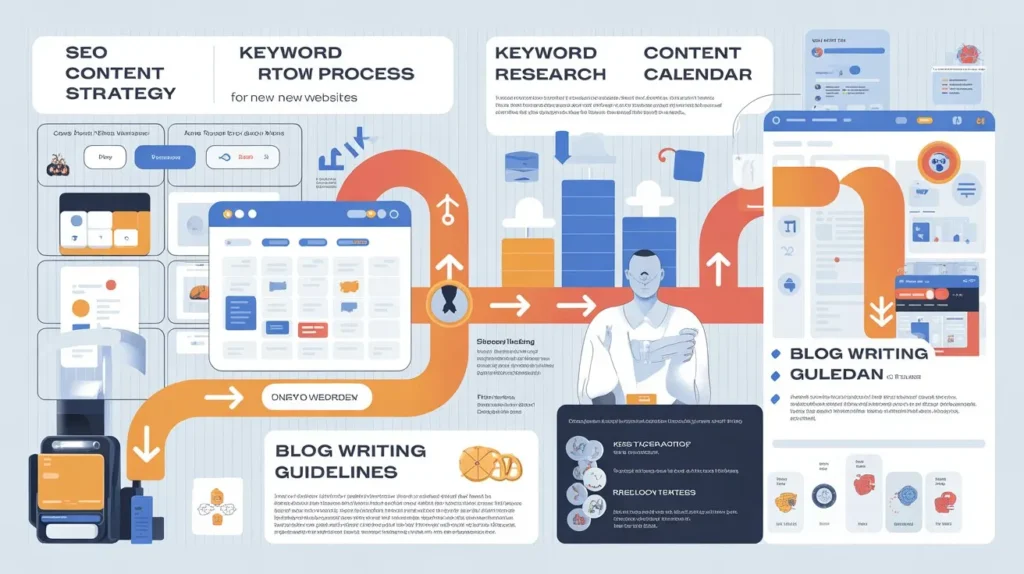
According to Ahrefs’ research on content and traffic, 90.63% of all web pages receive zero organic traffic from Google. The difference between the pages that rank and the 90% that do not is almost always keyword research and topical relevance, not writing quality.
Talk to a RankFX SEO specialist today, we will build a keyword map for your industry and show you exactly which search terms your ideal clients are using that your current content is not targeting.
What Does a Content Calendar SEO Plan for Consistent Traffic Actually Look Like?
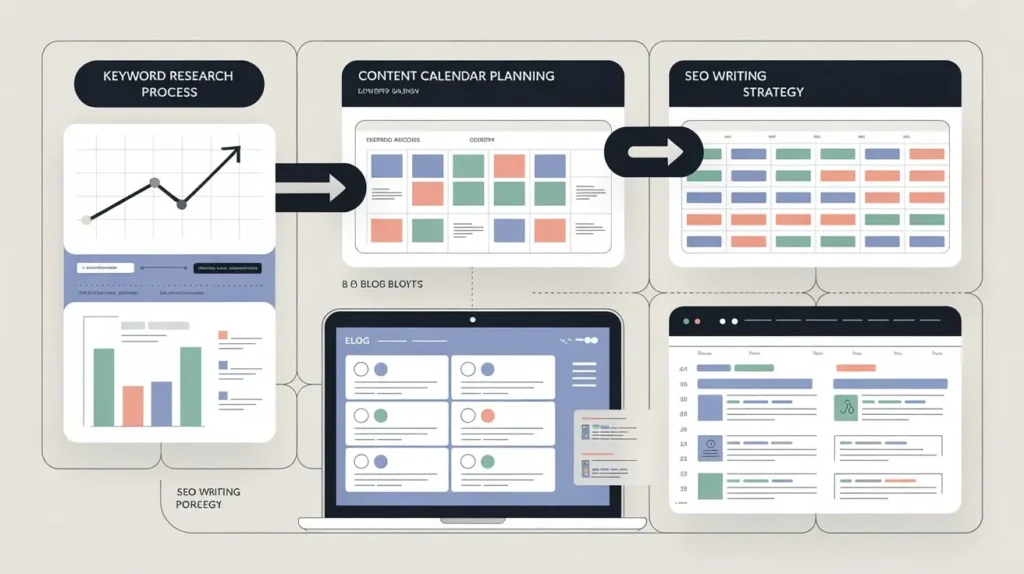
A content calendar SEO plan for consistent traffic is not a spreadsheet of publishing dates. It is a structured publishing sequence that builds topical authority in a deliberate order , starting with the foundations and expanding outward in a way that Google’s algorithm rewards progressively.
Here is what the first 6 months of a properly structured SEO content plan looks like for a service business.
Month 1 — Pillar content. Publish 2 to 3 long, authoritative articles that establish your expertise in your core service area. These are not sales pages, they are the most complete, honest, helpful answers to the biggest questions your ideal clients have. A web design agency publishes “How to choose a web design agency in 2026, what to look for and what to avoid.” A financial advisor publishes “How to pick a financial advisor in [city] , the questions most people forget to ask.” These pillar articles build the topical authority that makes every subsequent piece of content rank faster.
Month 2 — Supporting cluster content. Publish 4 to 6 shorter articles that answer specific sub-questions related to your pillar topics. Each one links back to the relevant pillar article. This cluster structure tells Google that your website has genuine depth on the topic, not just one good article, but an entire body of expert knowledge.
Month 3 — Decision-intent pages. Create or optimise the service pages and comparison content that capture readers at the moment they are ready to hire. “SEO agency vs in-house SEO, which is right for your business?” “How much does web design cost for a small business?” These pages convert existing traffic and generate new traffic from buyers in the final stage of their decision.
Month 4 to 6 — Local and industry-specific expansion. Publish content targeting your specific geographic markets and industry verticals. A marketing agency publishes content for “SEO for dental practices”, “SEO for law firms”, “SEO for accountants”, each one a specific, expert-level article that ranks for a niche search term and positions the agency as the specialist in that vertical.
Scenario — Type 6: The Specific Industry Win A financial planning firm in Melbourne began a structured content strategy in February 2024, targeting 22 specific search terms across three intent levels. Their pillar content, “How to choose a financial advisor in Melbourne: what ASIC registration means and why it matters”, ranked on page 1 within 9 weeks, targeting a search term with approximately 140 monthly queries. Within 5 months, 6 of their 22 target keywords had reached page 1. The decision-intent content, “Fee-only financial advisor Melbourne” (a term with 90 monthly searches and an average client value of AUD 4,500 per engagement), ranked at position 4. That single keyword generated an estimated 8 enquiry calls per month. With a 35% consultation-to-client conversion rate, that one ranked piece of content contributed approximately AUD 12,600 in new client revenue per month. Their entire content investment for the 5-month period was AUD 8,500.
The compounding effect of content strategy is what most businesses do not stay long enough to experience. The Melbourne firm’s content from month 2 is still generating enquiries in month 14, at zero additional cost. That is the fundamental difference between content as an asset and content as an expense.
The SEO Writing Strategy for Blog Posts That Actually Convert, Not Just Rank
Ranking is not the goal. Getting clients is the goal. And many businesses that finally start ranking discover their content generates traffic but no enquiries, because the content was written to rank, not to convert.
An SEO writing strategy for blog posts that convert requires four specific elements that most content misses.
A specific reader, not a general audience. Every piece of content should be written as if you are writing for one person with one specific problem. Not “business owners who need SEO” “a physiotherapy clinic owner in Birmingham who has watched a competing practice take the top Google Maps spot for the last 8 months and is ready to do something about it.” The more specifically you define the reader, the more powerfully the content converts when the right person finds it.
A clear problem-to-solution arc. The reader arrived because they searched for something. Your content must acknowledge that search, the problem behind it, before presenting a solution. Content that opens with a definition of its topic loses readers. Content that opens with “here is the exact situation you are in right now” holds them.
Evidence, not claims. Every claim in your content needs a specific number, a real scenario, or an authoritative source to support it. “SEO generates leads” is a claim. “A physiotherapy clinic in Birmingham that ranked for ‘physio near me Birmingham’ received 22 additional enquiry calls per month within 6 months” is evidence. Evidence converts. Claims do not.
A single, specific next step. Every piece of content needs one clear conversion pathway, one action the reader should take if the content resonated with them. Not three options, not a general “contact us” buried in the footer. One specific, low-friction invitation that follows naturally from what they just read.
Scenario — Type 4: The Honest Failure A business coaching firm in Singapore published 24 blog articles over 8 months using an SEO writing strategy focused entirely on keyword optimisation, the right keywords, the right word counts, the right heading structures. By month 8, 11 of those articles ranked on page 1. Monthly organic traffic had grown from 120 visits to 1,840 visits. Client enquiries from the website: 2. The disconnect was conversion. The articles ranked but did not convert because every one of them ended with a generic “contact us to learn more” CTA and no scenario, no specific offer, no evidence of outcomes. Traffic without conversion architecture is just data. After adding specific client scenarios to 8 of the 11 ranked articles, and replacing the generic CTA with a specific “book a 20-minute strategy call, no pitch, just a look at where your business is right now” invitation, enquiry volume from those 8 articles increased to 11 per month within 6 weeks. The rankings did not change. The conversion architecture did.
This is the most common content strategy failure I see, and it is entirely fixable. Rankings without conversion design produce data. Rankings with conversion design produce clients.
The businesses that get the most from their content strategy treat every article as a sales asset, not a publishing obligation. If our article on why your website is not showing on Google search describes your situation, the content strategy gap is almost certainly part of what is holding your Google visibility back.
How Long Before an SEO Content Strategy Generates Clients?
I won’t pretend this is a fast fix, but here is what the real timeline looks like for a business that executes a content strategy correctly.
Weeks 1 to 4: Content is published. Google crawls it. It sits in what the SEO industry calls the “Google Sandbox”, a period where new content from new or low-authority websites is evaluated before being ranked competitively. You will see almost nothing in your analytics during this period.
Weeks 5 to 12: Google begins testing your content in search results for low-competition long-tail keywords. You will start seeing impressions in Google Search Console, your content appearing in results, occasionally in the top 20. A small number of clicks will begin arriving.
Months 3 to 5: For businesses executing the cluster content model correctly, this is when the first page one rankings appear, typically for lower-competition, longer-tail keywords first. Enquiries from these rankings begin arriving in small numbers.
Months 6 to 9: The compounding effect begins. Pillar content is ranking for its primary keywords. Cluster content is generating topical authority signals. New content published now ranks faster, often within 4 to 6 weeks instead of 3 to 5 months. Monthly enquiry volume from organic search reaches a level that makes the content investment clearly worthwhile.
Months 10 to 18: The content strategy becomes a client acquisition asset rather than an ongoing cost. Content published 8 months ago continues generating enquiries. New content reaches page one faster. The cost per client acquired through organic search drops as the asset base grows.
Honest limitation: This timeline assumes consistent, strategic execution, new content published every 2 to 3 weeks, proper internal linking between content pieces, and a website with at least basic technical health. Businesses with significant technical website problems, very high competition niches, or inconsistent publishing schedules will experience longer timelines. There is no version of content strategy that generates clients in week one. Anyone who tells you otherwise is selling something different from what they are describing.
Our full range of SEO services at RankFX Global includes a dedicated content strategy service, covering keyword research, content planning, SEO writing, and conversion optimisation, built as a client acquisition system, not a publishing calendar.
Book a free strategy call, no commitment, just a clear picture of what a content strategy built specifically for your business and industry would look like, and what it would realistically generate in client enquiries at each stage.
Final Thoughts
Part 1 — The Situation Mirror
If your website currently publishes content without a documented keyword strategy, your content is competing for search terms by accident rather than by design. Your articles may rank for things your ideal clients never search. Your best potential clients may be searching for exactly your service, and finding a competitor whose content was built around the terms they use, not the terms you assumed they use. Every month your website publishes without a strategy is a month your topical authority gap with better-positioned competitors grows slightly wider and takes slightly longer to close.
Part 2 — The Honest Offer
What RankFX Global will do is review your current content, identify which of your existing articles are close to ranking for commercially valuable keywords, map the keyword gaps your ideal clients are searching that your website is not addressing, and show you what a structured content plan built for client acquisition looks like for your specific industry. What you get from that conversation is a content roadmap, not a vague publishing calendar, but a prioritised list of articles to write, the keywords each one targets, and the expected timeline before each one starts generating enquiries. There is no proposal unless you want one. There is no minimum commitment.
Part 3 — The Direct Invitation
If your website is publishing content but not generating client enquiries, that disconnect has a specific cause, and it is fixable. Get in touch with RankFX Global today, share your website URL and tell us which clients you most want to attract, and we will show you exactly what your SEO content strategy needs to do differently.
FAQs
1. What is an SEO content strategy to rank and get clients fast?
An SEO content strategy to rank and get clients fast is a structured publishing plan that targets the specific keywords your ideal clients search at each stage of their buying decision, awareness, consideration, and decision, with every piece of content designed to convert readers into enquiries.
2. How do I create an SEO content strategy for a new website with no rankings?
How to create an SEO content strategy for a new website starts with building a topic map of every question your ideal clients ask, identifying which search volume, and publishing in a deliberate sequence, pillar content first, supporting cluster content second, decision-intent pages third.
3. What does a keyword research process for an SEO content plan actually involve? The keyword research process for an SEO content plan involves identifying search terms across all three intent levels, awareness, consideration, and decision, then prioritising by commercial intent and ranking difficulty, not just search volume.
4. How long before a content calendar SEO plan generates consistent traffic?
A content calendar SEO plan for consistent traffic typically begins showing meaningful organic traffic between months 3 and 5 for lower-competition keywords, with significant client enquiry volume appearing between months 6 and 9 for businesses publishing consistently and strategically.
5. What makes an SEO writing strategy for blog posts convert readers into clients?
An SEO writing strategy for blog posts that convert requires a specific reader profile, a problem-to-solution arc that opens with recognition rather than definition, specific evidence rather than general claims, and one clear conversion pathway, not multiple generic CTAs.
6. How do I get a content strategy built specifically for my business and industry? Reach out to the RankFX Global team for a free content strategy review, share your website and the client type you most want to attract, and we will show you exactly which keywords your ideal clients are searching that your current content is not targeting.