
An attorney bio only does its job if it survives three separate tests at once a stranger decides to trust you in the first two sentences, a state bar reviewer finds nothing to flag, and an AI answer engine can lift your credentials as verified fact rather than skip past marketing language it can’t parse. Most law firm bios fail at least one of these. Very few are built to pass all three on purpose.
Key Takeaways
- A bio that opens with “has over X years of experience” gives a reader nothing to act on and nothing to remember.
- Bar advertising rules apply to bio pages the same way they apply to any other attorney marketing , outcome language and unverified superlatives are the most common violations.
- AI answer engines increasingly source “best [practice area] attorney in [city]” queries from structured, schema-tagged bio content, not flowing prose.
- Solo and small-firm bios carry more conversion weight per page than bios at large firms, where a visitor has other attorneys to fall back on.
- The strongest bios are produced through an attorney interview, not a form the attorney fills out alone at 11pm.
Why Most Attorney Bios Get Skimmed and Closed
A prospective client lands on a bio page already anxious. They’re not there to confirm you passed the bar , they assume that. They’re trying to answer one question fast: has this person actually done this before, for someone like me?
The standard opening line , “Attorney [Name] has over 15 years of experience in family law, personal injury, and estate planning” , answers a question nobody asked. It’s unfalsifiable, it’s identical to the bio next to it, and it tells a reader nothing about whether this attorney has sat across the table from someone in their exact situation.
This is where practice-area breadth becomes a liability in bio writing specifically. A bio that lists eight practice areas signals a generalist to a reader looking for a specialist. Even at firms where that breadth is real and valuable, the bio should lead with the one or two matters this attorney is known for handling , not a full menu. This is closely related to how the rest of the site is structured; see our breakdown of law firm website design for how bio pages fit into the site’s broader content architecture.
What a Bio Needs to Actually Earn Trust
A bio a stranger reads to the end usually does five things, roughly in this order:
- States who the attorney serves and what kind of matter, specifically , not “family law,” but “contested custody cases involving relocation disputes.”
- Signals lived familiarity with the reader’s situation , one sentence acknowledging what the process feels like from the client’s side, not the attorney’s.
- Provides checkable facts , bar admission state, law school and graduation year, and years in the specific practice area (not total years practicing law, which often overstates relevant experience).
- Shows a person, briefly , a genuine detail, not a hobbies list bolted onto the end for the sake of having one.
- Makes the next step obvious , direct contact information, not a buried “contact us” link three scrolls down.
Bulleted credential lists (bar admissions, education, honors) still belong on the page , they’re scannable, they’re what a referral source checks first, and they carry search-relevant keywords. The mistake is leading with them instead of using them to support a narrative that’s already established trust.
Bar Advertising Rules Don’t Skip the Bio Page
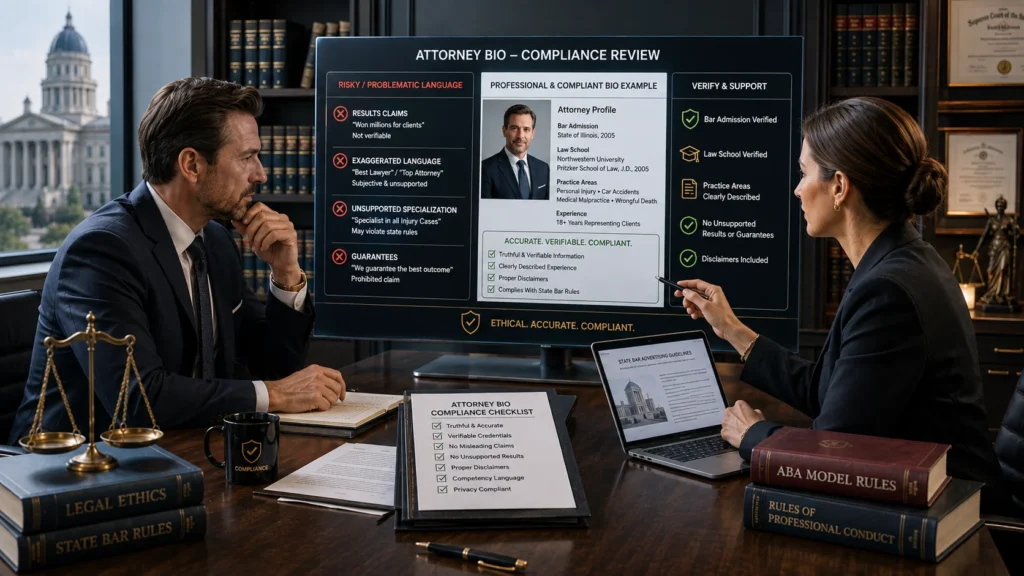
A bio page is attorney advertising in every state that regulates lawyer marketing, and it’s reviewed against the same standard as any other promotional page on the site. Most state rules trace back to ABA Model Rule 7.1, which turns on whether a statement could mislead someone deciding whether to hire the attorney , not whether it’s technically false.
The recurring problem areas in bios specifically:
- Outcome language. “I win my clients’ cases” implies a guarantee no attorney can make. Even indirect phrasing , “I get results” can draw scrutiny depending on the jurisdiction.
- Unverified superlatives. “Top-rated,” “best,” or “leading” attorney claims typically need a named, verifiable source (a specific award, a specific ranking body) or they don’t belong in the copy at all.
- Specialization claims. “Specializing in” language is restricted in a number of states unless the attorney holds a formal board certification recognized by that state’s bar. “Focuses on” or “concentrates on” is the safer default absent certification.
This is usually a gap in in-house-written bios not because anyone was careless, but because whoever drafted it an associate describing their own career, a paralegal working from a template wasn’t thinking about advertising rules while writing a paragraph about themselves. A compliance pass against your specific state’s rules should happen before a bio ships, not after a bar complaint flags it.
Structuring a Bio So AI Search Can Actually Use It
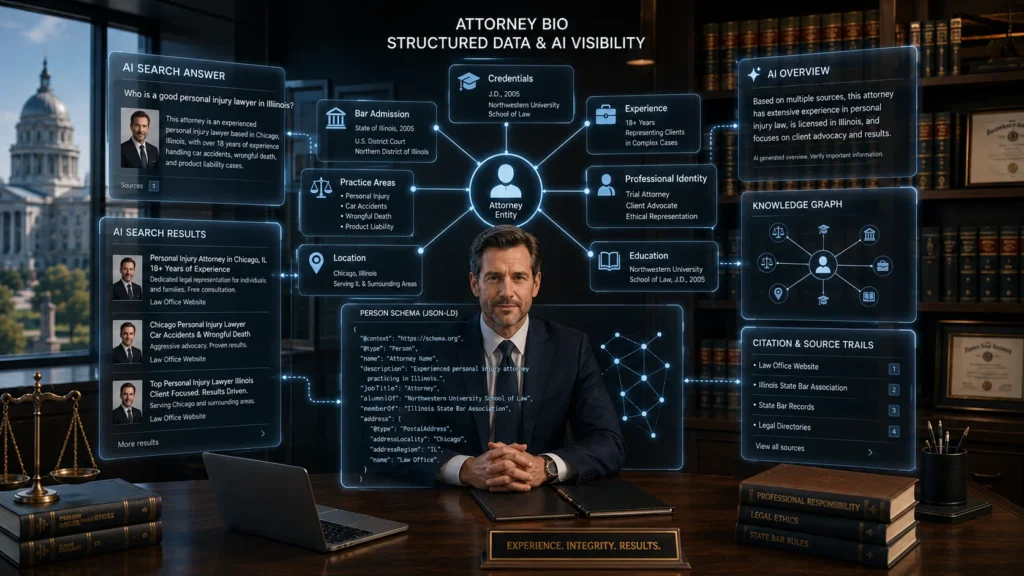
A growing share of “best [practice area] lawyer near me” searches now resolve inside ChatGPT, Perplexity, or Google’s AI Overview instead of a traditional results page. These systems assemble answers from content they can parse cleanly into facts , which means a bio needs two layers working together:
- Readable prose for the human visitor deciding whether to call.
- Structured data , Person schema markup tagging name, credentials, admissions, and practice area as machine-readable fields , for the systems deciding whether to cite the attorney at all.
A bio written purely as marketing prose, with no schema underneath it, is harder for an AI system to extract with confidence. When that happens, a competitor’s page , often one with less compelling writing but cleaner structured data gets named instead. Google’s own guidance on how structured data works is worth having your developer review directly rather than assuming your CMS handles it by default, since a lot of law firm site builders don’t add Person schema unless someone specifically asks for it.
Worth being direct about the limits here: a well-written, properly tagged bio won’t move rankings on its own, and it won’t get an AI tool to cite a firm it doesn’t already treat as credible sitewide. A bio page supports the site’s broader authority signal , on its own, it rarely earns a citation. Losing that sitewide credibility is also the fastest way to watch a previously ranking page slide back down; our guide on recovering from a sudden Google ranking drop covers the same authority signals from the other direction , what happens when they erode instead of build.
Small Firms Need a Different Bio , Not a Smaller One
A solo attorney or a two-to-five-lawyer firm carries more risk on a single bio page than a 40-attorney regional firm does. At a larger firm, a visitor who isn’t convinced by one bio can click to another attorney and stay on the site. At a small firm, that bio page often is the deciding factor , there’s no bench to fall back on. The bio doesn’t exist in isolation either it’s one piece of the same attorney website design that determines whether a visitor ever reaches it in the first place.
That means the bio has to work harder on the “why this specific person, in this specific practice area, in this specific city” question, and it’s usually the shortest, cheapest content fix available to a small firm that’s already invested in practice-area page writing. It also tends to pull more direct-name-search traffic than owners expect, particularly from queries like “[attorney name] reviews” or “[attorney name] lawyer.”
In-House vs. Agency: Where Each One Actually Helps
| In-house | Agency | |
| Knows the attorney’s actual case history and voice | Yes, by default | Only if the interview is done well |
| Gets prioritized against active casework | Rarely , bios get pushed | Scheduled as its own deliverable |
| Applies bar advertising review consistently | Depends who wrote it | Should be built into the process |
| Adds schema / AI-readable structure | Rare, unless specifically requested | Should be standard |
| Costs | Time, not dollars | Flat fee or hourly, varies by scope |
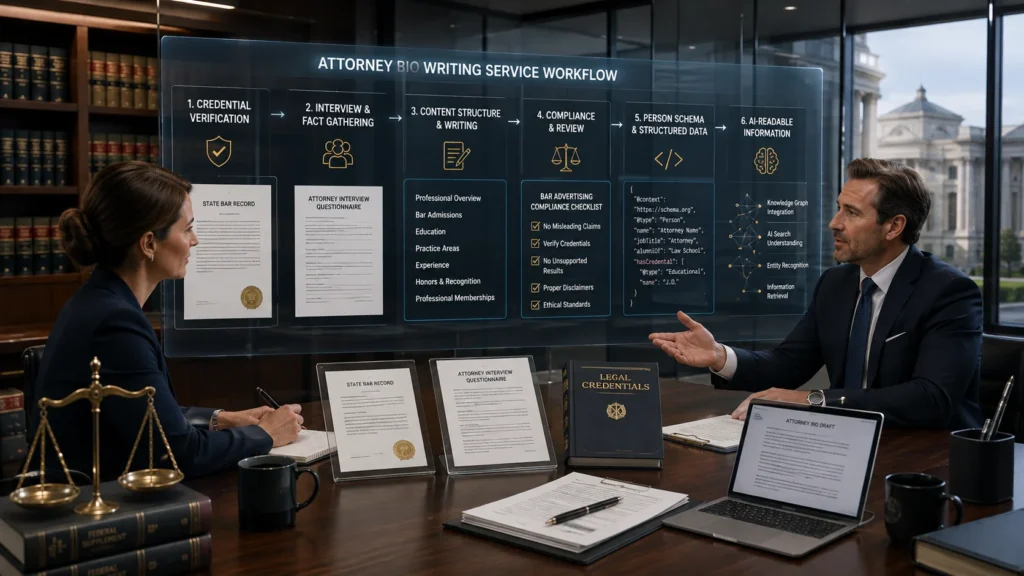
The honest middle ground for most firms: the attorney supplies the real material , a case type handled repeatedly, why they chose the practice area, a genuine trade-off they walk clients through , through a live interview rather than a blank questionnaire, and a writer shapes that into copy structured for both a skeptical reader and an AI extraction pass.
Timeline and Cost
A single, well-researched bio , interview, drafting, a compliance pass, and schema markup , typically runs one to two weeks, longer if bar records need verification across more than one state. A full-firm rebrand covering every attorney’s bio scales with headcount and how quickly attorneys complete their interviews; eight to twelve weeks is a realistic range for a firm with a full roster.
Pricing varies by research depth, attorney seniority, and whether schema and compliance review are bundled in, so treat any flat number you see quoted elsewhere as directional rather than binding , get a scoped quote against your actual attorney count before budgeting. For how that same research-depth-vs-price logic plays out on the SEO side of a legal marketing budget, see how much SEO actually costs.
FAQ
Can a bio mention specific case results or outcomes?
Only within what the relevant state bar permits, and usually with a required disclaimer attached. Several states restrict case-result claims in advertising outright, so this needs to be checked against that specific jurisdiction’s rules rather than assumed from a template.
Does every attorney at a firm need a full-length bio?
Not necessarily. Early-career associates are often better served by a shorter profile, while partners and attorneys who originate business typically warrant the fuller, case-specific treatment.
Should the attorney or the marketing team write the bio?
Neither alone tends to produce a strong result. The attorney’s actual voice and case history paired with a writer who structures it for readability, bar compliance, and AI extraction is what consistently works.
How often should an existing bio be updated?
At least once a year , outdated case counts, old honors, and practice areas the attorney no longer handles are the most common reasons a bio stops converting even though nothing was ever “wrong” with it.
Is a compliance review included, or a separate step?
This varies by provider , confirm whether bar advertising review is bundled into the writing engagement or billed as a separate pass before you scope the project.
Ready to get your firm’s attorney bios doing all three jobs , earning trust, passing bar review, and structured for AI citation? See what’s included in RankFX Global’s legal content writing service.