
Law firm website design that performs is built on four things: a fast, mobile-first site structure; content organized around the questions a prospective client is actually asking; schema markup that helps Google and AI answer engines understand who you are and where you practice; and clear conversion paths that don’t bury your phone number or contact form. Get those four right, and everything else rankings, leads, credibility follows from a solid foundation, not a shortcut.
Most law firm sites fail for reasons that have nothing to do with color palettes or stock photography. They fail because the homepage doesn’t say what the firm does or where, the contact form is three clicks deep, or the site takes six seconds to load on a phone in a parking lot outside a courthouse. None of that is glamorous, but it’s what separates a site that generates calls from one that just exists.
The pressure on firms to get this right has changed shape. Search results now surface AI-generated overviews before organic listings, and those overviews pull from sites that answer questions clearly and completely not sites optimized purely for keyword density. A firm’s website is no longer just a digital brochure; it’s the primary source material AI tools and search engines draw from when deciding whether to recommend that firm at all.
This isn’t a pitch for urgency. It’s a case for building the site correctly the first time, because rebuilding a poorly structured legal site later costs more in lost visibility than doing it right costs up front.
What Law Firm Website Design Actually Includes
Law firm website design covers three layers working together: the technical foundation, the content architecture, and the conversion mechanics. A site that nails the visual design but ignores any of the other two will underperform regardless of how it looks.
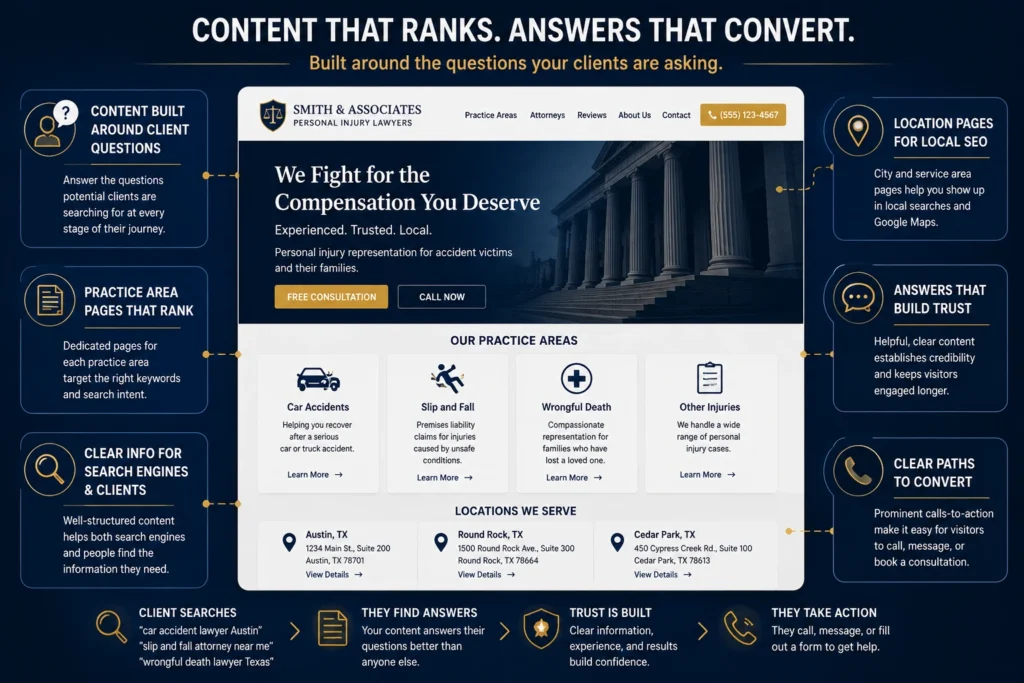
The technical layer includes hosting speed, mobile responsiveness, SSL security, and clean code that search engines can crawl without friction. The content layer covers practice area pages, attorney bios, and location pages structured around how real clients search “car accident lawyer” behaves differently in Google than “personal injury attorney,” even within the same practice area. The conversion layer is everything that turns a visitor into a call: click-to-call buttons, visible office hours, intake forms that don’t ask for more information than a first contact warrants.
Schema markup ties these layers together. Adding LegalService and Attorney schema to a site gives search engines and AI tools explicit, machine-readable facts about the firm practice areas, service locations, attorney credentials rather than forcing them to infer it from page copy. For a YMYL (Your Money or Your Life) topic like legal services, that explicit clarity matters more than it does for lower-stakes industries, because Google applies a higher bar for trust signals on content that affects someone’s finances, safety, or legal standing.
Law Firm Website Design vs. In-House: How to Decide
Building the site with an in-house resource a paralegal who knows WordPress, a partner’s nephew who does freelance design usually costs less upfront and nothing ongoing beyond hosting. It also usually means the site plateaus once that person’s available time runs out, and legal-specific compliance knowledge (state bar advertising rules, ADA accessibility, schema for legal entities) has to be learned from scratch rather than applied from experience.
An agency built specifically around law firm website design vs. in-house teams typically brings faster execution, established compliance patterns across multiple state bars, and infrastructure analytics, technical SEO tooling, ongoing maintenance , that’s expensive to replicate for a single site. The tradeoff is cost and a loss of some day-to-day control.
The honest answer depends on your bandwidth and your growth timeline. A firm with one attorney and no urgency to expand can reasonably keep design in-house. A firm actively trying to grow caseload in a competitive market usually can’t afford the learning curve an in-house build requires, because every month spent fixing avoidable technical issues is a month a competitor’s site is compounding its own authority.
What to Look for in Law Firm Website Design Reviews and Case Studies
Reading law firm website design reviews is useful, but only if you know what to filter for. Star ratings alone tell you almost nothing they reflect general client satisfaction, not whether the resulting site actually ranks or converts. Look instead for specifics: did the review mention page load times, mobile performance, or actual traffic and lead outcomes? Vague praise (“great to work with,” “very professional”) is common and largely uninformative.
Case studies deserve the same scrutiny. A legitimate case study names the practice area, the market, and a realistic, hedged outcome over a stated time period not a bare percentage increase with no baseline. “Organic leads increased over an eight-month period following a full content and technical rebuild” is a defensible claim. A number with no context, timeframe, or starting point is not, and any agency presenting one that way is worth a second look.
Ask directly for examples of live sites, not just before-and-after screenshots. A live site lets you check load speed, mobile behavior, and whether the design still holds up months after launch screenshots can’t show you any of that.
Compliance and Trust Signals Your Site Can’t Skip
Legal advertising sits under more regulatory scrutiny than most industries, and website design isn’t exempt. Every state bar publishes advertising rules that can apply to website claims, client testimonials, and case result language the ABA’s Model Rules of Professional Conduct set the baseline framework most states adapt, and a firm’s own state bar site is the authoritative source for the specific version that applies.
Accessibility compliance is a separate but related requirement. The Americans with Disabilities Act has increasingly been interpreted by courts to apply to websites, and firms of all businesses face particular exposure if their own site isn’t accessible to visitors using screen readers or other assistive technology. Practical accessibility work includes proper heading structure, alt text on images, sufficient color contrast, and keyboard-navigable forms, aligned with WCAG (Web Content Accessibility Guidelines) standards.
None of this is optional polish. A firm that gets sued over its own site’s accessibility, or that draws a bar complaint over testimonial language on a homepage, has a design problem that became a liability problem.
Finding Law Firm Website Design Near You vs. Working Remotely
Searching for law firm website design near me makes sense if a firm values in-person meetings or wants a local point of contact for revisions. It doesn’t meaningfully affect the quality of what gets built. Website design and legal SEO are remote-native disciplines the work happens in a CMS, in analytics dashboards, and in Google Search Console, none of which require physical proximity.
What matters more than location is whether the team understands the legal niche specifically: state bar advertising boundaries, practice-area search behavior, and the trust signals search engines expect from YMYL content. A generalist local web designer without that context will produce a site that looks fine and underperforms; a remote specialist in legal marketing will usually outperform a local generalist on the metrics that actually matter rankings, leads, and case intake.
If local presence is a firm priority for reasons beyond the website itself, that’s a legitimate preference. It just shouldn’t be confused with a quality requirement.
Core Web Vitals, Mobile Experience, and Technical Foundations
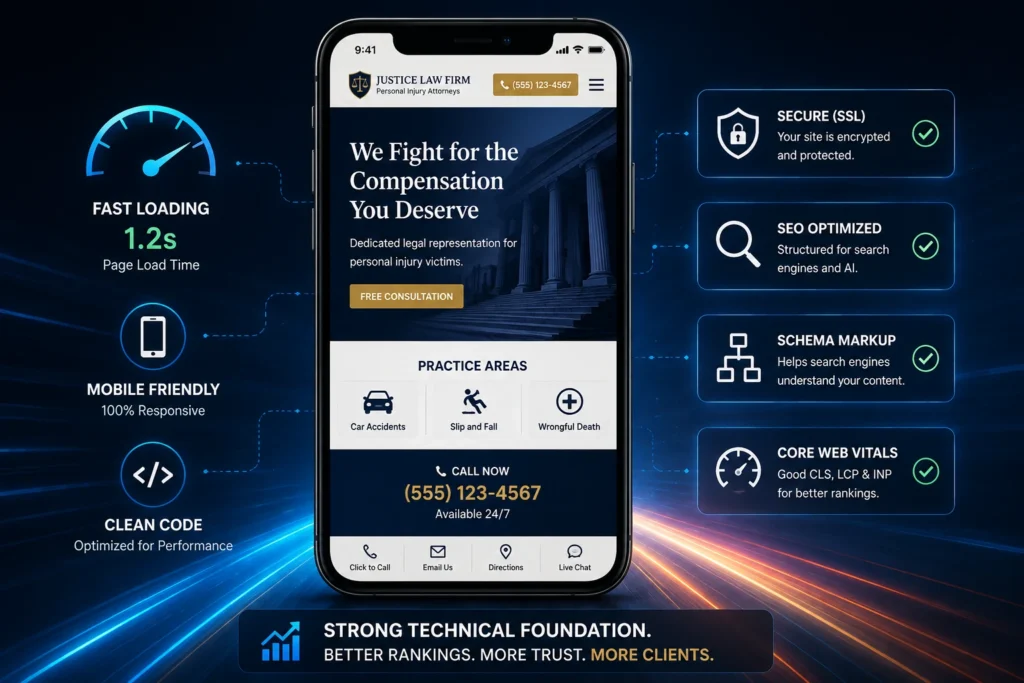
Core Web Vitals Google’s specific metrics for loading speed, interactivity, and visual stability directly affect both search rankings and whether a visitor stays on the page long enough to call. A slow-loading practice area page loses potential clients before they ever read a word of copy, regardless of how well that copy is written.
Mobile experience carries particular weight for law firms because a large share of legal searches “DUI lawyer near me,” “workers comp attorney” happen on a phone, often in a moment of urgency. A site that isn’t fully responsive, with tap-friendly buttons and a phone number that’s clickable rather than just visible, loses exactly the leads most motivated to convert immediately.
Hosting quality, image compression, and clean underlying code all feed into these metrics. A visually elaborate site built on outdated infrastructure will consistently underperform a simpler, faster one search engines and users both reward speed over decoration.
What a Realistic Next Step Looks Like
None of this happens overnight, and any firm promised fast rankings from a website rebuild should treat that promise skeptically. Legal SEO and website performance improvements typically play out over months, not weeks, and results vary by practice area, market competitiveness, and how much technical debt the previous site carried.
What’s realistic is a clear-eyed starting point: a technical and content audit that shows exactly where a current site is losing visibility or leads, and what a defensible timeline looks like based on the firm’s specific market and practice areas. That’s a more useful next step than a guarantee, because it’s the one thing an honest agency can actually stand behind.
Firms weighing this decision can review RankFX Global’s approach to legal website work directly, or reach out to talk through what a rebuild or audit would realistically involve for a specific practice area and market.
Frequently Asked Questions
How much does law firm website design typically cost?
Costs vary widely based on scope, but a professionally built law firm site with proper technical SEO and compliance work typically runs from a few thousand dollars for a smaller, template-based build to well into five figures for a fully custom, multi-practice-area site. Ongoing maintenance and content updates are usually a separate, recurring cost.
Does website design affect SEO rankings directly?
Yes. Site speed, mobile responsiveness, and clean technical structure are direct ranking factors, and poor design often creates the technical problems slow load times, broken mobile layouts, crawl errors that suppress rankings regardless of how good the content is.
How long does a law firm website redesign take?
A straightforward redesign typically takes six to twelve weeks depending on the number of practice area pages, content volume, and how much custom design work is involved. Larger, multi-location firms usually take longer.
Do I need a lawyer to review website content for advertising compliance?
It’s a reasonable precaution, particularly for testimonial language, case result claims, and any comparative statements. State bar advertising rules vary, and a firm’s own bar counsel or compliance officer is the right resource to confirm specific language is acceptable.
Is WordPress a good platform for law firm websites?
WordPress is a common and workable choice for law firms because of its flexibility and wide plugin ecosystem, but the platform matters less than how it’s configured caching, security hardening, and clean theme code determine performance far more than the CMS choice itself.

4 Responses