
Legal content writing services provide law firms with practice area pages, case results summaries, and attorney bios written by people who understand both legal advertising rules and search intent. A reputable provider combines subject-matter research with semantic SEO structure, so pages inform prospective clients and meet Google’s standards for legal, or YMYL, content. Cost and scope vary by firm size, practice area, and how much research each page requires.
If you searched for legal content writing services, you’re probably trying to decide between hiring a specialist, assigning the work to an associate, or drafting pages yourself between client matters. That decision matters more than it used to. Search engines and AI answer tools now reward content that fully resolves a reader’s question in one place, using consistent terminology and verifiable claims not thin pages built around a keyword.
For law firms, the stakes are higher than for most industries. Legal pages fall under Google’s YMYL (your money or your life) content standards, which means thin or inaccurate writing doesn’t just underperform in rankings it can actively damage a firm’s credibility with the people reading it. At the same time, state bar advertising rules constrain what a firm can claim about outcomes, making generic marketing copy risky in ways it isn’t for other industries.
This is where dedicated legal content writing services differ from general copywriting. The work has to hold up to both search algorithms and bar association scrutiny at the same time.
What Legal Content Writing Services Actually Cover
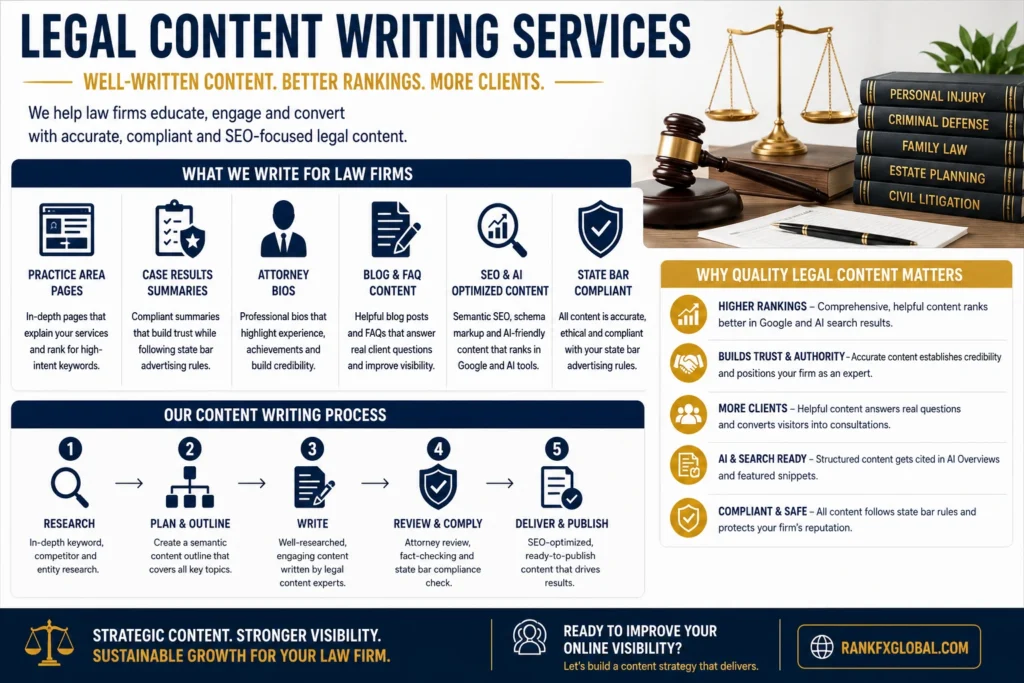
A complete legal content writing engagement typically includes practice area pages, location pages for firms with multiple offices, case results or outcomes pages (written within advertising rule limits), attorney bio pages, and ongoing blog content answering the questions prospective clients are actually searching. Some providers also write FAQ sections structured for featured snippets and AI extraction, using schema markup like FAQPage to help search engines parse the content.
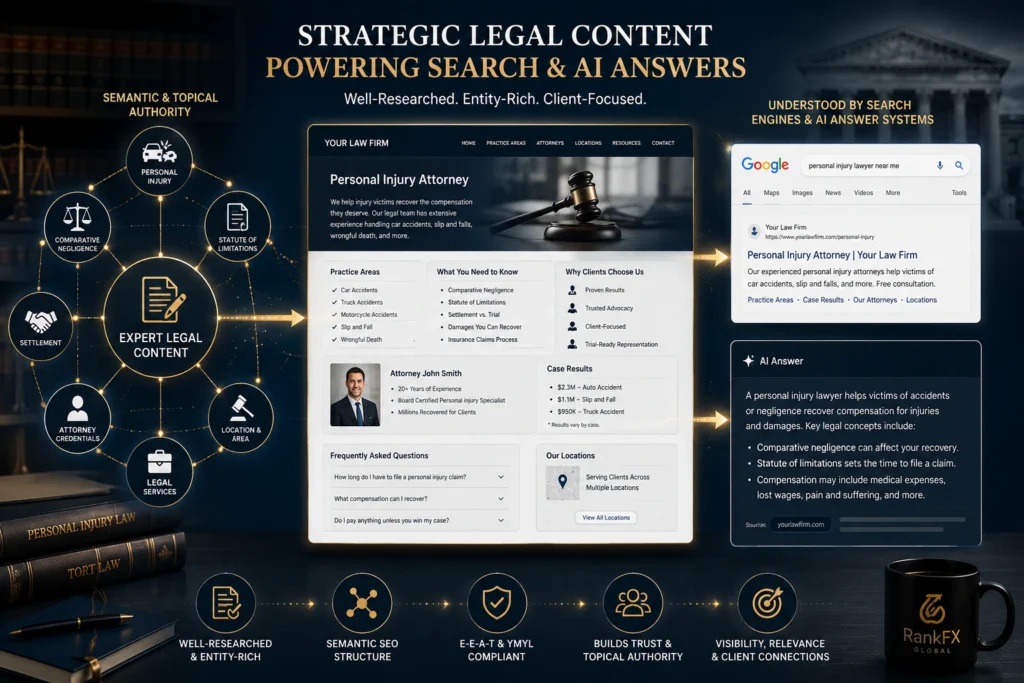
The strongest providers write with semantic SEO in mind, not just keyword placement. That means covering the full set of concepts a genuinely complete page on a topic would include for a personal injury page, that’s comparative negligence, statute of limitations, and settlement versus trial, not just the phrase “personal injury lawyer” repeated at intervals. It also means using one consistent term for each concept throughout a site, rather than switching between synonyms in a way that fragments the topical signal search engines are trying to read.
Firms considering this work alongside broader visibility efforts often pair it with our Legal SEO, GEO, and AEO services, since content and technical SEO reinforce each other rather than functioning as separate projects.
Case Studies: What Results Look Like in Practice
Legal content writing services case studies, when they’re honest, describe a range of outcomes rather than a single guaranteed number. A page rewrite for a practice area with heavy competition might take months to show meaningful ranking movement, while a location page for an underserved market can see faster indexation simply because fewer competitors have written anything comparable.
What a credible case study should show is process: what research went into the page, which entities and questions it covers that competitors’ pages don’t, and how it was structured for both human readers and AI answer engines. Be skeptical of any case study built around a specific ranking timeline or a client acquisition number with no context practice area, market size, and starting position all affect what’s realistic, and no agency controls Google’s algorithm.
Legal Content Writing Services for Small Law Firms
Solo attorneys and small firms often assume content writing is only worth it at scale, but the opposite is frequently true. A small firm with a narrow practice area and a defined local market can compete for specific, high-intent searches that a national firm’s generic pages don’t fully address. The content doesn’t need volume it needs depth on the exact questions a potential client in that market is asking.
Budget is the real constraint for small firms, and it shapes scope more than anything else. A realistic starting point is usually three to five core practice area pages written well, rather than a dozen written thin. Firms in this position should also weigh content against other priorities, like an incomplete Google Business Profile and map pack presence, since local pack visibility often drives more immediate calls than blog content for a solo practice.
Legal Content Writing Services vs In-House: Weighing the Trade-offs
The in-house option looks cheaper on paper an associate or marketing coordinator already on payroll writing pages between other work. In practice, the trade-off is time and consistency. Attorneys are expensive labor for writing tasks, and marketing coordinators without SEO training often produce pages that read well but don’t cover the entity set search engines and AI tools are looking for.
Outsourced legal content writing services cost more per page upfront but typically deliver content built around keyword research, competitor gap analysis, and semantic structure from the start. The honest answer is that neither option is universally better: a firm with strong in-house legal writing talent and someone who understands SEO structure may not need outside help. A firm without that combination is usually better served by a specialist, at least for the pages that carry the most search volume.
One middle path worth considering is a hybrid model , attorneys review and fact-check content that a specialist researches and structures, which keeps legal accuracy in-house while outsourcing the writing and SEO mechanics.
Getting Started: Free Consultation and What to Ask
Most legal content writing services free consultation calls follow a similar format: a review of your current site content, a gap analysis against competitors, and a rough scope of what pages would move the needle first. Before that call, it’s worth asking a provider a few direct questions: Do they have experience writing for your specific practice area? How do they handle case results content given state bar advertising restrictions? What does their research process look like before a page is drafted?
Pricing questions matter too, but the more useful question is what’s included at that price a page written from a template with your firm’s name inserted is a different product than one built from actual keyword and entity research, even if the invoice looks similar.
If you want a straightforward look at what this would involve for your firm specifically, our contact page is the fastest way to start that conversation.
Where This Leaves Your Firm
Legal content writing services aren’t a shortcut to fast rankings, and any provider who implies otherwise is worth questioning. What they can genuinely offer is content that fully answers what a prospective client is searching, structured in a way that both search engines and AI answer tools can parse and trust which, over a realistic timeline, is the actual lever available to any firm competing for visibility online.
The right next step depends on where your site currently stands. A firm with thin or outdated practice area pages benefits most from a full content audit before committing to new writing. A firm with solid pages but no supporting blog content is often better served starting there. Either way, a free audit is a reasonable way to see exactly where your firm stands and what a realistic timeline looks like not a promise of overnight results, but a clear picture of the work involved.
Google’s own guidance on helpful, reliable content is a useful baseline for evaluating any content writing provider’s approach, legal or otherwise , if a provider’s process doesn’t align with it, that’s worth asking about directly.
FAQs
Do legal content writing services write case results pages?
Some do, within the limits set by state bar advertising rules, which vary by jurisdiction and often require disclaimers about case-specific outcomes. Ask any provider how they handle this before assuming it’s included.
How much do legal content writing services cost?
Pricing varies widely based on page count, research depth, and practice area complexity , there’s no single industry-standard rate, and firms should be cautious of quotes given without reviewing the site first.
Can a small firm see results from content writing without a large budget?
Yes, particularly in narrower or less competitive practice areas, though the timeline and scope will look different than for a firm with a larger content budget.
Is in-house content writing ever the better choice?
For firms with attorneys or staff who already understand both legal writing and SEO structure, yes. For most firms, that combination is rare enough that outside help fills a real gap.
What makes legal content different from general business content writing?
YMYL standards, state bar advertising restrictions, and the need for defensible, non-invented claims all apply specifically to legal content in ways that don’t affect most other industries.