
Law firm Google Maps optimization is the process of improving how a firm’s Google Business Profile ranks in the three-listing map pack, based on relevance, distance, and prominence , the three factors Google itself names as the core inputs to local ranking. For most firms, that means a fully completed profile, a steady flow of recent reviews, accurate practice area categories, and a website that backs up what the profile claims. Distance can’t be changed, but relevance and prominence usually can.
If your firm shows up on page one of Google but not in the three-pack at the top, you’re losing the clients who never scroll past it. Map pack results sit above almost every organic listing on a “[practice area] lawyer near me” search, and on mobile , where most of these searches happen , they’re often the only thing visible without scrolling at all.
This is different from general SEO in a few ways that actually matter for law firms specifically. Bar advertising rules govern what you can say in a GBP post or a review response. YMYL standards apply extra scrutiny to legal content, including profile descriptions. And the searches themselves carry more urgency than most , someone searching “DUI lawyer open now” wants an answer in seconds, not a comparison shopping experience.
Here’s what actually goes into ranking there, what doesn’t, and where firms tend to waste effort.
What Are the Three Factors That Actually Determine Map Pack Ranking?
Google itself explains that local results come down mainly to relevance, distance, and popularity working together to surface the best match for a search. Relevance measures how well your profile matches the search terms someone used. Distance measures how close your office is to the person searching, or to the location named in the search. Prominence measures how well-known and trusted your firm appears to be mostly driven by review volume and quality, but also by citations and links from other sites.
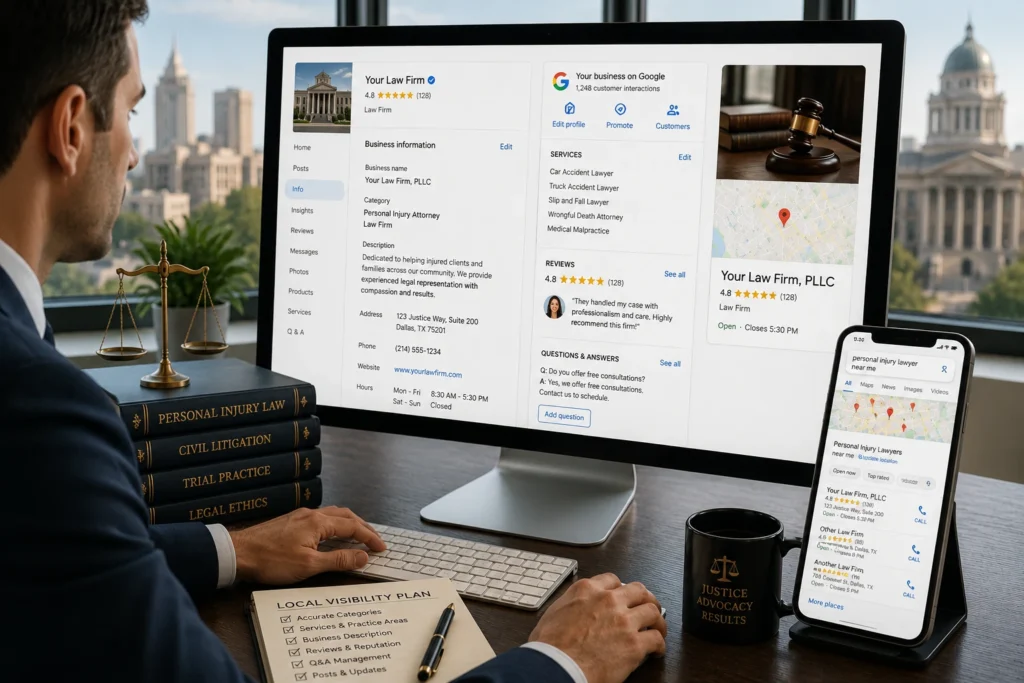
Only two of these three are things you can actually influence. You can’t move your office closer to a searcher, and no legitimate agency can promise otherwise , anyone who claims to “fix distance” is selling something that doesn’t exist. Relevance and prominence, though, respond directly to work you can do.
Relevance: Making Your Profile Actually Match the Search
Relevance starts with your category selection, and this is where a surprising number of law firm profiles get it wrong. Choosing “Lawyer” as your only category when you practice personal injury specifically means Google has less signal to match you against a “personal injury lawyer near me” search than a competitor who selected the specific category.
Your business description, services list, and posts should use the same terms a prospective client would actually type not internal legal terminology. Someone searching rarely types “tort litigation.” They type “car accident lawyer” or “slip and fall attorney.” Matching that language, consistently, across the profile is what relevance actually rewards.
Q&A sections and review responses count here too, even though firms often ignore them. If reviews mention specific practice areas or outcomes (within what bar rules allow you to acknowledge), that reinforces relevance signal Google is already picking up from elsewhere on the profile.
Prominence: Why Reviews Carry More Weight Than Firms Expect
Prominence is where most of the ranking movement actually happens, and reviews are the biggest lever inside it. This isn’t just about star rating review velocity (how recently and consistently you’re getting new reviews) matters as much as the average score. A firm with 40 reviews from two years ago, all 5-star, can rank behind a firm with 25 reviews and a steady trickle of new ones each month.
There’s a compliance wrinkle specific to legal here that general small-business SEO advice doesn’t cover: soliciting reviews that reference case outcomes or specific results can run into bar advertising restrictions depending on your state. A review saying “they won my case and got me $200,000” isn’t something you control directly, but how you respond to it, and whether you actively encourage that kind of language when asking clients for reviews, is something your firm’s process should account for.
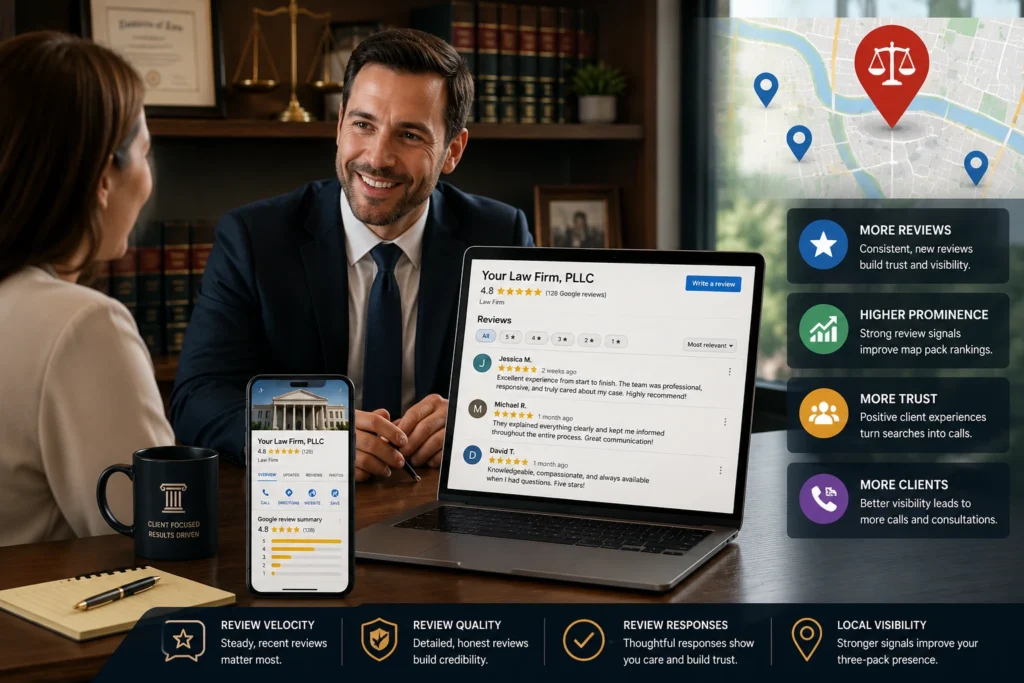
Citations your firm’s name, address, and phone number appearing consistently across legal directories, your own website, and other authoritative sites build prominence too. Inconsistent NAP information (a different suite number on your website than on your GBP, for instance) quietly undermines this signal even when nothing looks obviously wrong to a human visitor.
Law Firm Google Maps Optimization vs. In-House Management
Firms with a marketing coordinator sometimes handle GBP management internally, and for basic upkeep , responding to reviews, posting updates, keeping hours accurate , that works fine. Where in-house management tends to fall short is on the technical and strategic side: category selection based on actual search volume data, structured review-generation systems, and diagnosing why a profile’s ranking dropped after a Google update.
A profile can also get suspended for policy violations that aren’t always obvious , using a virtual office address, keyword-stuffing the business name field, or having a category mismatch flagged by an automated review. Recovering from a suspension can take weeks and cost real visibility in the meantime, which is often where firms decide ongoing management is worth outsourcing even if the day-to-day posting stays in-house.
If your profile has dropped in the map pack recently or you’re not sure why it’s not showing for searches it should rank for, a free visibility audit can identify the specific issue before it costs you more calls.
Does Your Website Affect Map Pack Ranking?
Yes, indirectly. Google’s local algorithm pulls signal from your website , page speed, mobile usability, and whether your site content matches what your GBP claims about services and location. A slow or poorly structured law firm website can quietly undermine map pack performance even when the GBP itself is fully optimized, because Google cross-references the two.
Website accessibility plays into this too, though it’s often overlooked. Beyond the legal exposure , the ADA governs accessibility for businesses serving the public, and law firm websites aren’t exempt an inaccessible site (missing alt text, poor contrast, unusable on mobile) sends weaker engagement signals that can affect how Google evaluates the site backing your profile.
Practice area pages matter here as well. If your GBP lists “Family Law” as a category but your website has no dedicated family law content, that mismatch is a relevance gap Google can detect, and it’s one that well-structured practice area content closes directly.
What Does Law Firm Google Maps Optimization Cost, and How Long Does It Take?
Pricing for dedicated GBP and map pack work is usually lower than a full SEO campaign, often falling in the $300–$800 monthly range as a standalone service, though most firms bundle it into a broader SEO, GEO, and AEO strategy rather than buying it separately.

Timeline expectations should be realistic: GBP and map pack changes tend to show visible movement faster than full-site SEO, often within a few weeks rather than months, since Google processes profile updates on a shorter cycle than a full site re-crawl. That said, prominence built through review velocity takes sustained effort over months, not a one-time push , a burst of ten reviews in a week followed by silence doesn’t build the same trust signal as a steady, ongoing pattern.
FAQs
What’s the difference between Google Maps optimization and general SEO for law firms?
Google Maps optimization specifically targets the three-listing map pack through your Google Business Profile, while general SEO targets organic rankings on your website they’re related but rely on different signals and often need separate strategies.
How many reviews does a law firm need to rank in the map pack?
There’s no fixed number; review velocity and recency generally matter more than total volume, meaning a steady flow of new reviews outperforms a large batch from years ago.
Can a law firm have multiple Google Business Profiles for different practice areas?
Generally no , Google’s guidelines require one profile per physical location, though firms with multiple offices can and should have a separate, accurately located profile for each.
Why did my law firm’s map pack ranking suddenly drop?
Common causes include a Google algorithm update, a policy flag on the profile (often related to categories or address issues), a drop in review velocity, or a competitor improving their own signals a visibility audit can usually identify which.
Is Google Maps optimization worth it for a solo attorney?
Often more so than for larger firms, since map pack visibility tends to have an outsized effect on smaller practices with limited advertising budgets and heavy reliance on local, high-intent searches.
RankFX Global provides Google Business Profile and local map pack optimization built exclusively for U.S. law firms, with every strategy accounting for bar advertising rules from the start. Get a free audit to see exactly where your firm’s map pack visibility stands today.