
Law firm map pack ranking is decided by three factors Google defines itself , proximity, relevance, and prominence , measured almost entirely through your Google Business Profile, not your website. Firms move up by tightening GBP category selection, earning reviews at a steady pace, keeping business information consistent everywhere it’s listed, and building genuine local signals. There’s no fixed timeline, and Google has never published exact weighting.
The Map Pack Isn’t the Same Ranking System as Your Website
Most firms that call us start with the same assumption: if the website is ranking well organically, the map pack should follow. It doesn’t work that way, and treating them as one system is where a lot of wasted budget starts.
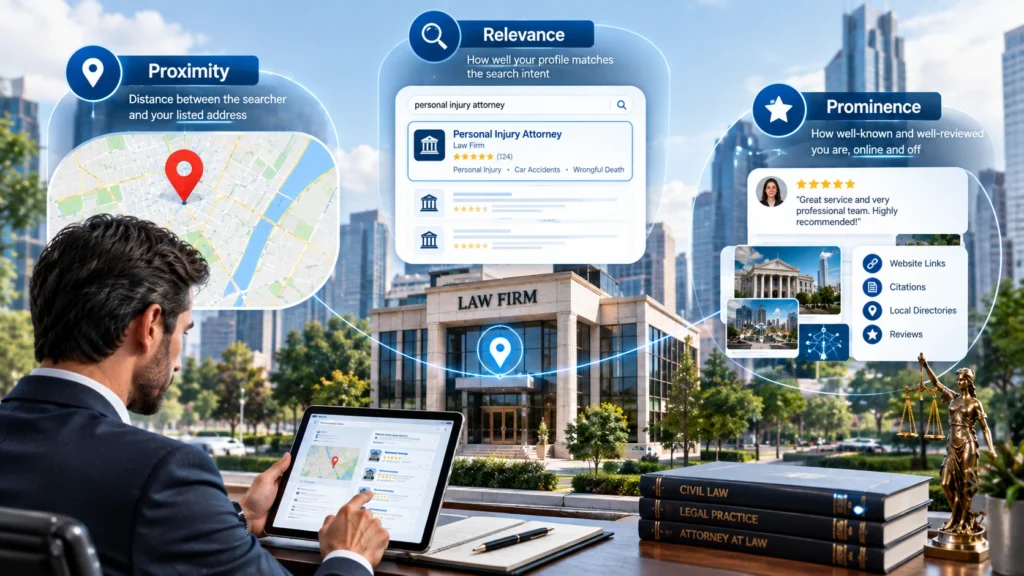
Organic rankings are built from your website , content depth, backlinks, technical health , all of it evaluated as a single page-level entity. Map pack ranking is built from your Google Business Profile as a separate entity, cross-referenced against your website but not governed by it. A firm can sit at position one organically for “personal injury attorney [city]” and still show up fourth or fifth in the three-pack, because the map pack is answering a different question: which physical, verifiable business is closest, most relevant, and most established for this search, right now.
That distinction matters because it changes where the SEO work should actually go. If you’re pouring budget into blog content while your GBP category is set wrong, you’re optimizing the system that isn’t the bottleneck.
What Actually Determines Map Pack Ranking?
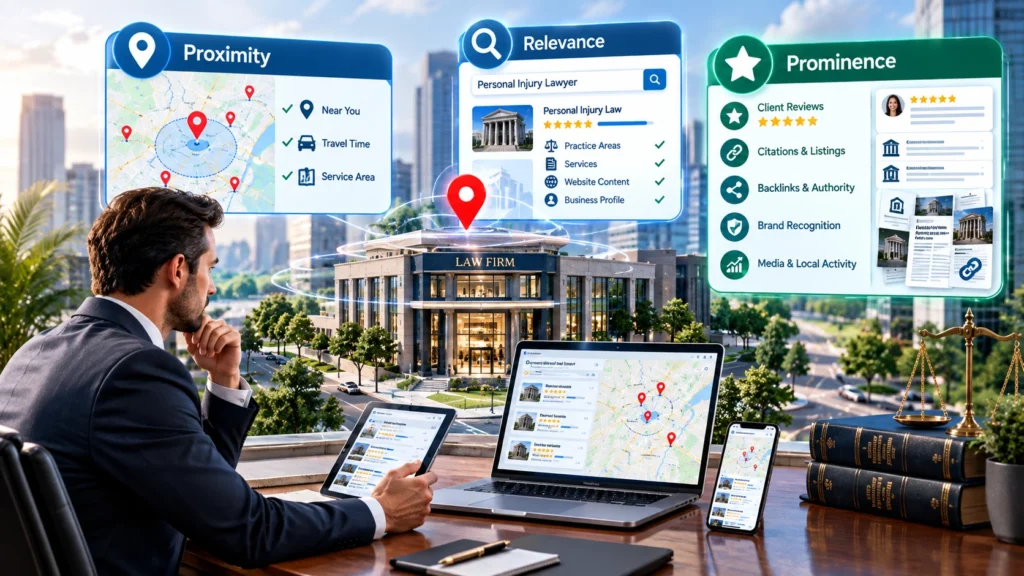
Google names three ranking factors for local results, and none of them is a mystery , the ambiguity is in how they’re weighted, not what they are.
| Factor | What it measures | What law firms usually get wrong |
| Proximity | Distance between the searcher and your listed address | Using a virtual office or shared suite address that doesn’t match a real, staffed location |
| Relevance | How well your profile matches the search intent | Picking a broad primary category (“Lawyer”) instead of a specific one (“Personal Injury Attorney”) |
| Prominence | How well-known and well-reviewed the business is, online and off | Treating reviews as a one-time push instead of an ongoing habit |
Google’s own guidance on local ranking confirms that relevance, distance, and prominence are the three factors it uses, and prominence in particular draws on signals from across the web, not just what’s on the profile itself (Google Business Profile Help: Tips to improve your local ranking). For a full walkthrough of how these apply specifically to the profile setup itself, our Google Business Profile optimization guide for law firms goes section by section through category selection, service area configuration, and description structure.
None of the three factors operates alone. A firm two miles from the searcher with a tightly relevant category and strong reviews will usually outrank a firm half a mile away with a vague category and a thin review profile. Proximity gets too much credit in most agency pitches because it’s the easiest to explain , it’s rarely the deciding factor on its own.
Why Two Firms in the Same City Rank Differently
This is the question that actually keeps managing partners up: two firms, same practice area, same neighborhood, and one shows up in the pack while the other doesn’t. Usually it comes down to a handful of compounding gaps rather than one obvious mistake.
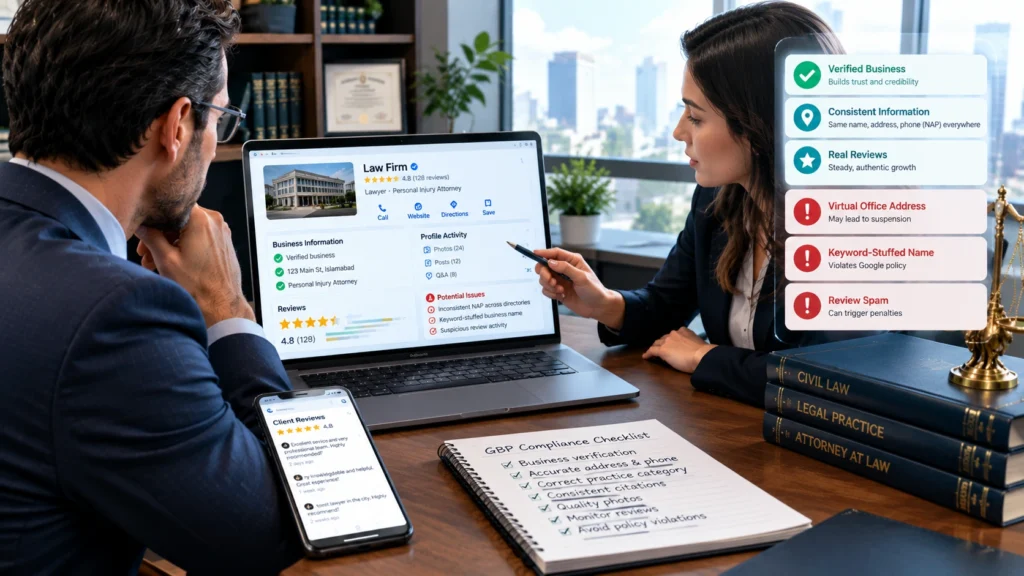
Review velocity is one of the more underrated ones. A firm with 40 reviews collected steadily over two years tends to outperform a firm with 60 reviews that all landed in a single month-long push, because a sudden spike reads as manufactured rather than organic , to both Google’s systems and to a searcher scrolling past it. Citation consistency is another: if your firm’s name, address, or phone number differs even slightly across your website, GBP, and directory listings like Avvo or Justia, that inconsistency dilutes the prominence signal instead of reinforcing it.
Photo count and recency matter more than most firms expect, too. Profiles with regularly updated, geotagged photos of the actual office , not stock imagery , tend to hold position better over time, likely because it’s one of the few signals that’s hard to fake convincingly at scale.
For firms building out the content layer that supports these signals , practice area pages that reinforce relevance, location-specific service descriptions our practice area page writing service is built around that exact gap between a generic “Personal Injury” page and one that actually maps to the categories and terms your GBP is being judged against.
The GBP Suspension Risk Nobody Warns You About
Here’s the part most agencies skip because it’s uncomfortable to bring up: an aggressive push to improve map pack ranking can get a profile suspended, and a suspended profile ranks nowhere.
The most common triggers we see with law firm clients are shared or virtual office addresses that don’t reflect a real, staffed location; keyword-stuffed business names (“Smith Law , Best Personal Injury Attorney [City]” instead of just the firm’s actual legal name); and review bursts that look coordinated, especially when several reviews land within days of each other using similar phrasing. Multi-attorney and multi-office firms carry an extra layer of risk here, since Google’s guidelines on how to structure profiles for practitioners within a larger firm are stricter than most people assume, and getting that structure wrong can trigger a suspension review that takes weeks to resolve.
None of this is meant to scare a firm out of pursuing map pack visibility , it’s meant to explain why “just get more reviews fast” is bad advice, even when it sounds harmless.
If a suspension risk like this already applies to your firm’s profile, or you’re not sure whether it does, that’s worth a direct look before any more content or review requests go out. Our GBP and local map pack service starts with exactly that kind of audit.
How AI Overviews Are Changing the Map Pack
The map pack itself is starting to sit alongside , and sometimes underneath , an AI-generated summary that pulls from two or three firms at once, synthesizing review sentiment and profile details rather than just listing results in order. That summary layer reads review text for sentiment, not just star ratings, and it appears to weigh whether a profile shows evidence of a real, active office , recent photos, updated hours, responses to reviews , more heavily than a static, unchanged profile with the same numeric rating.
This is still an area where the exact mechanics aren’t published anywhere, and any firm claiming to have it fully reverse-engineered is overstating what’s actually known. What’s observable is that profiles treated as a maintained asset , updated regularly, responded to consistently , are the ones showing up in these AI-generated summaries more often than profiles that were optimized once and left alone.
What a Realistic Timeline Actually Looks Like
This is the part worth being blunt about: map pack movement is typically measured in months, not weeks, and a firm in a competitive market like personal injury or family law in a major metro should expect a longer runway than a firm in a smaller city or a less contested practice area. Nobody controls Google’s algorithm, and any agency promising a specific ranking position by a specific date is telling you something they can’t actually back up.
Google’s own content guidance frames helpful, reliable, people-first content as the standard to build toward rather than a specific ranking mechanic to game (Google Search Central: Creating Helpful, Reliable, People-First Content), which is a useful reframe for map pack work too , the goal is a profile and web presence that genuinely reflects a real, well-run firm, not a set of signals assembled purely to satisfy an algorithm.
One more honest note on reviews specifically: soliciting them isn’t unregulated. ABA Model Rule 7.2 governs how lawyers can communicate about their services, and firms building a review-generation process should have that process checked against their state bar’s specific rules before rolling it out broadly , what’s compliant varies by jurisdiction in ways a generic marketing playbook won’t catch.
Frequently Asked Questions
Does map pack ranking depend on my website’s SEO?
It’s connected but not dependent , your website reinforces relevance and prominence signals, but a strong website alone won’t fix a poorly configured GBP.
How many reviews does a law firm need to rank in the map pack?
There’s no fixed number; steady, ongoing review growth from real clients matters more than hitting a specific count.
Can a virtual office address hurt map pack ranking?
Yes , Google’s guidelines require a real, staffed location, and virtual or shared addresses are one of the more common suspension triggers for law firms specifically.
How long does it take to improve map pack ranking?
Typically months rather than weeks, with competitive practice areas and metros taking longer than smaller markets or less contested categories.
Should each attorney at a firm have their own GBP listing?
Sometimes, but the structure has to follow Google’s rules for practitioners within a larger organization closely , getting it wrong is a common cause of suspension for multi-attorney firms.
Do AI Overviews replace the traditional map pack?
Not yet , they’re appearing alongside it in many searches, pulling from the same underlying profile signals rather than replacing the three-pack outright. outright.