

77% of new dental patients search Google before booking an appointment, and the practice that appears first gets the call. The second practice gets ignored. Your practice is losing real bookings right now to a competitor down the road who simply ranked higher, not because they are better, but because someone helped their website show up first. By the end of this article, you will know exactly what SEO services for dentists to get more patients actually involve, what they cost, and why your Google Business Profile is either your most powerful patient acquisition tool or your biggest missed opportunity in 2026.
Dental SEO is not standard SEO with a tooth logo on it. It is a highly specific discipline built around how anxious, time-pressed patients search for care they trust. A dental clinic SEO strategy to rank on Google’s first page must answer three patient questions simultaneously: Is this practice near me? Does it look trustworthy? Do other patients recommend it? Generic agencies answer none of these correctly. Which is why most dental websites rank poorly despite looking polished.
Is your dental practice invisible on Google right now? Contact RankFX Global for a free dental SEO audit — we respond within 24 hours.
Key Takeaways
- 77% of new dental patients find their dentist on Google first, making SEO the highest-ROI patient channel for any practice
- Dental practices with fully optimised Google Business Profiles receive 46% more appointment calls within 60 days of setup
- A practice with 80 genuine Google reviews consistently outranks a competitor with a better website but only 12 reviews
- The single most important action today: search “dentist near me” from your practice location, if you are not in the top 3 Maps results, you are losing patients every hour
Why Your Dental Website Is Invisible on Google Right Now

Most dental practices have the same problem. The website looks professional. The treatments are listed. The contact page works. But the phone barely rings from online enquiries. The reason is almost always the same: the site was built to look good, not to rank.
Google evaluates dental websites against over 200 ranking signals, and most dental sites satisfy fewer than 30 of them. No treatment-specific pages. No suburb-level keyword targeting. A Google Business Profile that was set up once and never touched again. Zero review generation strategy. And a website that loads in 6 seconds on a mobile connection, which is how your patients are searching.
This is not a content problem. It is a structural problem. And if your competitor’s phone is ringing with new patient enquiries while yours is quiet, there is a specific, fixable reason for it. If you have noticed your rankings dropping recently, our article on search ranking recovery explains the exact diagnostic process for identifying what went wrong.
The three gaps that most consistently hold dental practices back from Google page 1 are a missing or poorly managed Google Business Profile, no dedicated pages for individual treatments and locations, and a review count that is too low to be competitive in the Google Maps Pack.
Talk to a RankFX SEO expert today, we will run a full audit of your practice website and Google Business Profile and show you exactly which of these gaps is costing you the most new patient bookings right now.
What SEO Services for Dentists to Get More Patients Actually Include
Here is what separates a dental SEO strategy that fills appointment books from one that generates reports nobody reads.
Treatment-specific landing pages are the foundation. A patient searching “teeth whitening [suburb]” needs to land on a page dedicated to your whitening service, with your price range, the procedure explained plainly, before-and-after photo examples, and a booking button above the fold. Your homepage cannot do this job. Each of your top 5 revenue-generating treatments needs its own page, its own local keyword target, and its own conversion pathway. Practices that build these pages consistently outrank those with a single generic “our services” page in every market we have worked in.
Google Business Profile management is not a set-and-forget task. Google rewards practices that post weekly updates, respond to every review within 48 hours, add new treatment photos monthly, and keep their service list current. A dormant GBP, set up two years ago with five photos and never touched, ranks significantly below an actively managed competitor profile, even if your actual practice is superior. Your GBP is a living ranking signal, not a digital business card.
Review generation strategy is the fastest ROI activity in dental SEO. A practice with 80 genuine reviews averaging 4.7 stars outranks one with 15 reviews at 5.0 stars in every local market. The patients who would happily review you are simply never asked in the right way at the right moment. A structured review request, sent via text or email within 24 hours of a positive appointment, generates responses at 4 to 5 times the rate of automated follow-ups sent weeks later.
E-E-A-T signals for healthcare content matter more in dentistry than in almost any other industry. Google classifies dental content as YMYL, Your Money or Your Life, meaning it holds it to the highest quality and accuracy standards. Your treatment pages need the treating dentist’s credentials visible, qualifications verifiable, and clinical information accurate. Thin, generic content about “why oral hygiene matters” does not rank. Specific, expert-authored content about “what to expect during a root canal at our Mayfair practice” does.
How Much Does Dental SEO Cost to Get More Patients in 2026?
Pricing reflects your market, your competition level, and how many treatments and locations you need to cover.
| Practice Type | Avg Monthly Budget | Timeline to Results | Primary Focus |
| Single practice — low competition | $500–$1,000 | 2–4 months | GBP + review strategy |
| Single practice — competitive suburb | $1,000–$2,000 | 3–6 months | Treatment pages + citations |
| Multi-location dental group | $2,000–$5,000 | 4–7 months | Separate GBP per location |
| Specialist (implants / orthodontics) | $1,500–$3,500 | 4–7 months | High-value keyword pages |
The ROI calculation is straightforward. A practice spending $1,500 per month on Google Ads at $15 cost per click gets roughly 100 ad clicks. Redirecting $800 of that budget to dental SEO typically generates 200 to 400 organic monthly visits from high-intent patient searches within 4 to 5 months, at zero cost per click thereafter. For a practice with a $2,000 average patient lifetime value, adding 5 new organic patients per month equals $10,000 in additional annual revenue from a single marketing channel that compounds over time.
Google Ads stops the moment your budget pauses. Organic rankings keep working on a Sunday morning when your practice is closed and a patient in pain is searching for care.
If your practice has never appeared on page 1 despite having a website for years, the problem is likely one of the issues our guide on why your website is not showing on Google search explains in detail, and most of them are fixable within 30 days.
Local SEO for Dentists: How to Appear When Patients Search Near You
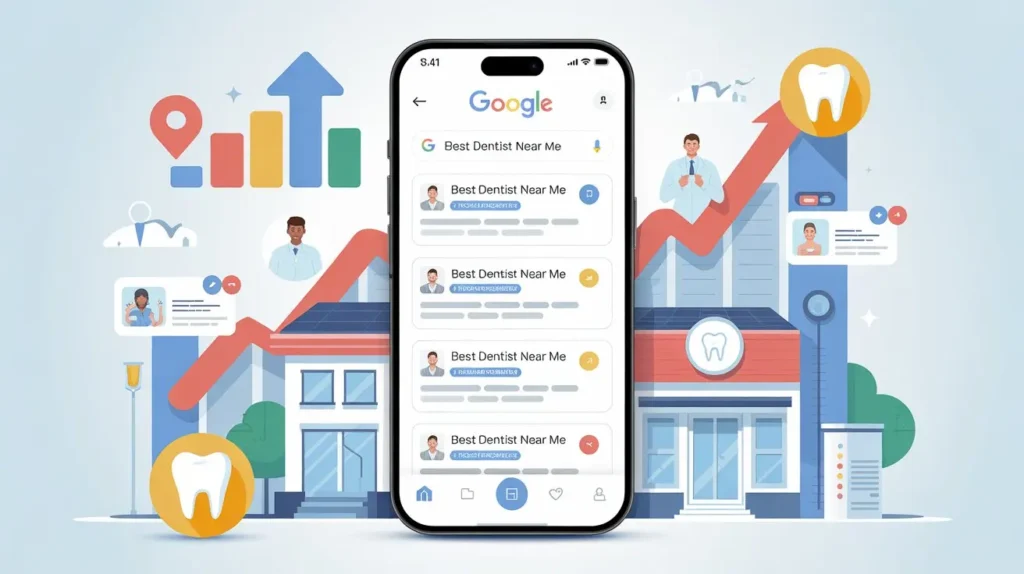
The Google Maps Pack, the three practices shown above organic results for “dentist near me” searches, generates the majority of new patient calls for local practices. Appearing in those three positions is the single most impactful visibility improvement your practice can make.
Ranking in the Maps Pack for dental searches requires three things done consistently.
First, your Google Business Profile must match your website exactly, same practice name, address, phone number, and services. Any inconsistency confuses Google’s local algorithm and suppresses your Maps ranking. Second, your review velocity matters as much as your review count. A practice earning 3 new reviews per week consistently outperforms one with a higher total count but no recent reviews. Third, your website must have at least one strong locally-targeted page for each suburb you realistically serve, not just your practice address location.
What surprised me working with dental practices across multiple markets is how few of them target suburb-level search terms below their immediate location. A practice in Jumeirah Beach, Dubai targets “dentist Jumeirah” but misses “dentist JBR”, “family dentist Dubai Marina”, and “emergency dentist Jumeirah Lakes Towers” , all searched daily by patients who would happily drive to the practice. These lower-competition neighbourhood terms often produce Maps Pack appearances within 6 to 8 weeks of optimisation, far faster than competing for broad city-wide dental terms.
According to HubSpot’s research on healthcare search behaviour, 72% of patients who search online for a healthcare provider visit a practice within 5 miles of their location. Your patient catchment area is small and hyperlocal. Your keyword strategy should be too.
Book your free consultation now , our team will map your exact patient catchment area and identify every suburb-level keyword your practice should be ranking for but currently is not.
Why Dental Practices Lose Rankings, and How to Get Them Back
If your practice used to appear well on Google and your rankings have dropped, there are three specific reasons this happens in the dental sector.
A competitor actively invested in SEO. They built treatment pages, generated reviews, and earned local citations while your profile stayed static. Their relevance signals grew. Yours did not. The result looks like a drop but is actually a displacement. If you have experienced this, our guide to why your competitor ranks higher on Google breaks down exactly how to close that gap systematically.
A Google algorithm update penalised thin or duplicate content. Many dental websites use template content, identical treatment descriptions across multiple practices. Google identifies and devalues this content in healthcare searches specifically. Replacing templated content with genuinely expert-authored, location-specific treatment pages typically recovers these ranking losses within 2 to 3 months.
A technical issue, a plugin update, a website migration, or a hosting change, accidentally blocked Google from indexing your pages correctly. This is more common than most dentists expect and is fully recoverable once identified. Working with a consultant who understands how to grow website traffic through technical fixes makes this recovery significantly faster.
Honest limitation: Dental SEO for cosmetic, implant, and orthodontic keywords in competitive urban markets takes 6 to 10 months before primary keyword page 1 visibility. Large dental groups and specialist practices have accumulated years of Google authority in these categories. The correct approach is to win suburb-specific and treatment-specific long-tail keywords first, these produce bookings from lower-competition searches while building the authority needed to compete for primary terms later.
Our full range of SEO services at RankFX Global includes a dedicated dental practice tier, Google Business Profile management, treatment page creation, review generation, and transparent monthly reporting on every keyword that moved and every new patient enquiry generated.
Final Thoughts
Your dental practice delivers excellent care. Your patients know it. But the patients who have not found you yet cannot know it, because your website is not where they are looking. The right SEO services for dentists to get more patients fix this gap systematically, treatment page by treatment page, review by review, suburb keyword by suburb keyword. Every week that passes without an active dental SEO strategy is a week your competitors strengthen their hold on the patients in your catchment area.
The dentists filling their books from Google in 2026 made a decision, usually 6 to 12 months earlier, to invest in organic search rather than depend entirely on paid ads. That compounding advantage is available to your practice right now. Get in touch with RankFX Global today and we will audit your practice website, your Google Maps position, and your competitor rankings, then show you exactly what it takes to get new patients calling your practice from Google every week.
FAQs
1. What do SEO services for dentists include to get more patients?
Dental SEO covers Google Business Profile management, treatment-specific landing pages, local keyword targeting, review generation, E-E-A-T credibility content, and technical fixes, all aimed at generating booked appointments directly from Google searches.
2. How does dental clinic SEO help my practice rank on Google’s first page?
Dental clinic SEO to rank on Google’s first page combines GBP optimisation, suburb-specific treatment pages, consistent review generation, and healthcare-quality content, the exact signals Google’s algorithm uses to rank dental practices above local competitors.
3. How long before dental SEO starts bringing in more patients?
Most practices see Google Maps ranking improvements within 6 to 10 weeks. Competitive cosmetic and implant keyword rankings typically take 4 to 8 months of consistent work, with patient enquiries increasing progressively throughout that period.
4. How much does an affordable dental website SEO expert charge per month?
A dental website SEO expert affordable for smaller practices starts at $500 to $800 per month for lower-competition areas. Practices in competitive urban markets or specialist fields typically need $1,500 to $3,500 per month for meaningful page 1 movement.
5. What is the fastest local SEO strategy for a dentist practice to get results?
The local SEO strategy for a dentist practice website that moves fastest combines a fully optimised Google Business Profile with an active review generation process, these two actions consistently produce Maps Pack ranking improvements faster than any other dental SEO tactic.
6. How do I get started with dental SEO today?
Reach out to our team at RankFX Global for a free dental practice SEO audit, share your website URL and practice location and we will send you a complete ranking analysis showing exactly why new patients are finding your competitors instead of you.