
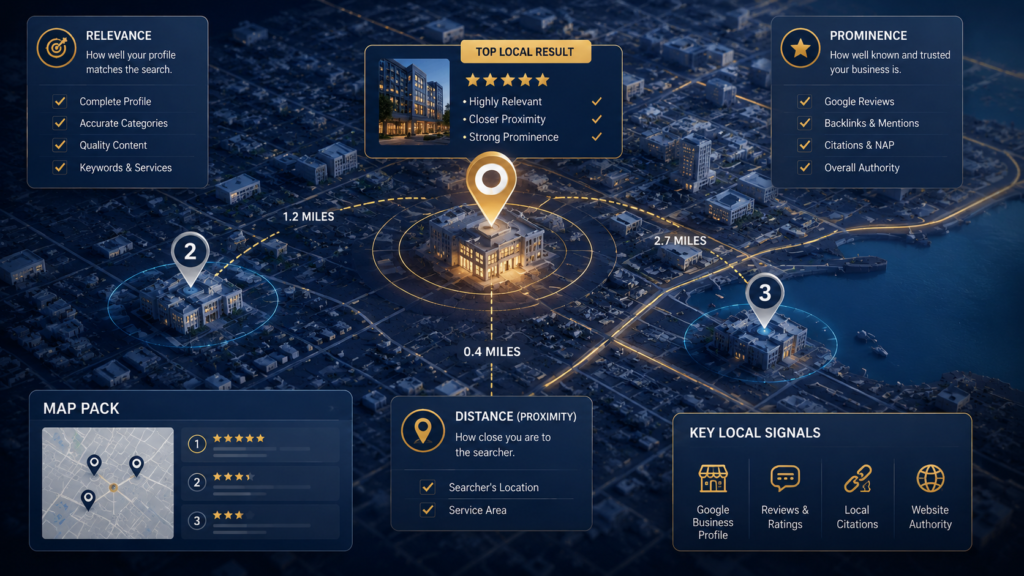
Local SEO for attorneys is the process of optimizing your Google Business Profile, website, and citation profile so your firm appears in the local map pack and organic results when someone in your service area searches for a lawyer. It relies on three confirmed Google ranking factors , relevance, distance, and prominence , plus a consistent, accurate presence across the web. There is no shortcut around these three; there’s only doing them well or poorly.
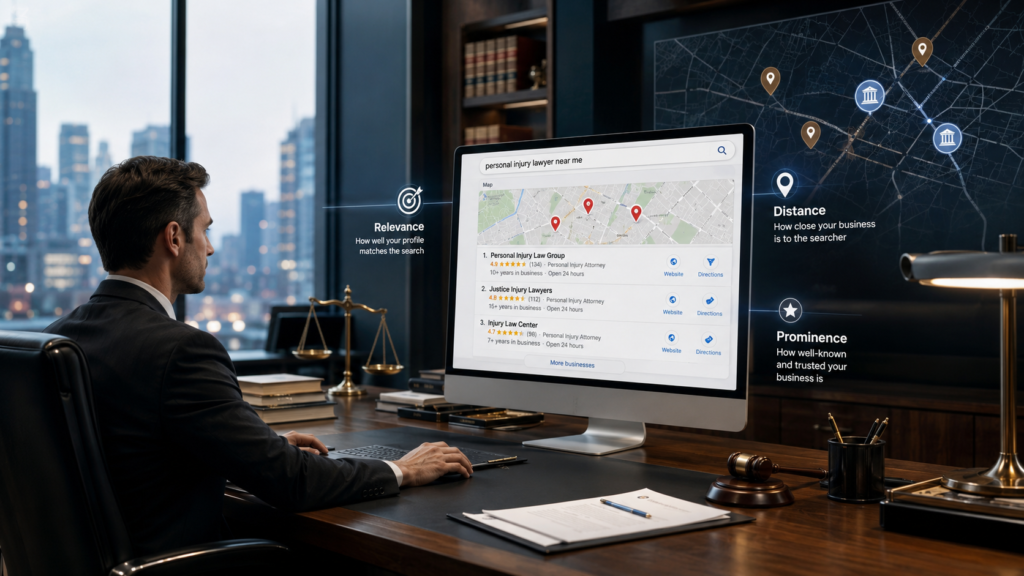
If a prospective client in your city searches “personal injury lawyer near me” right now, does your firm show up in the map pack? For most solo and small firms, the honest answer is “sometimes” or “not for the terms that matter.” That gap is rarely about talent or reputation. It’s usually about whether Google has enough clear, consistent signal to place your firm in front of that searcher instead of the firm two exits away.
This matters more this year than it did two years ago. AI Overviews, ChatGPT, and Perplexity are increasingly the first stop for someone comparing attorneys, and they tend to pull from the same structured, well-organized signals , Google Business Profile data, schema markup, and consistent citations , that traditional local search rewards. Firms that treat local SEO as a checkbox are losing visibility twice: once in the map pack, and again in AI-generated answers.
We’re not going to promise you an instant ranking in this article, and any agency that does is telling you what you want to hear, not what’s true. Meaningful movement in a competitive practice area typically takes several months of sustained work, though the map pack itself often responds faster than organic rankings do once a profile is properly optimized. What we can walk you through is what genuinely determines whether your firm shows up locally, and what a realistic path to improving it looks like.
What Determines Local Rankings for Law Firms
Google states plainly that local ranking depends on relevance, distance, and prominence, and none of the three can be substituted for another. According to Google’s own guidance on local ranking, prominence reflects how well-known a business is, based partly on how many websites link to it and how many reviews it has, with more reviews and stronger ratings helping local ranking. Relevance is how well your Google Business Profile (GBP) matches the searcher’s query your practice areas, categories, and business description all feed this. Distance is exactly what it sounds like: proximity between the searcher and your office or service area, which you can’t move but can clarify.

For law firms specifically, relevance gets complicated fast. A general “attorney” category signals almost nothing to Google compared to a profile built around specific practice areas personal injury, family law, criminal defense , matched to the actual language people search with. A firm that only lists “Law Firm” as its category is competing on distance and prominence alone, while a competitor with tightly matched categories and service descriptions is winning on all three factors at once.
There’s a compounding effect worth understanding here too: firms in high-stakes, high-search-volume practice areas like personal injury or medical malpractice face steeper prominence requirements than a niche estate planning practice in a smaller market, simply because more competitors are fighting for the same three map pack slots. What counts as “enough” prominence is relative to your specific market and practice area, not a fixed bar.
Google Business Profile Optimization for Law Firms
Your GBP is the single highest-leverage asset in local SEO for attorneys, because it’s the primary input for both relevance and prominence. A complete, active profile beats a sparse one even when the sparse one belongs to an older, more established firm.
The categories you select need to mirror your actual practice areas, not a generic label. Your business description should name specific services in plain language, the same language a client would type into Google, not internal firm jargon. Photos of your office, attorneys, and team humanize a listing that would otherwise look identical to a hundred competitors. And profile completeness compounds: an address, hours, phone number, and website that all match exactly what appears elsewhere online remove friction that would otherwise slow down verification and ranking. Our GBP and Local Map Pack service is built around this specific work, profile completeness, review growth, and the trust signals that keep a firm visible once it’s in the map pack.
None of this is a one-time setup. Profiles that go stale , outdated hours, no new photos, no posts, tend to lose ground to profiles that show ongoing activity, because activity is one of the signals Google reads as a proxy for a real, operating business.
The Map Pack, Citations, and NAP Consistency
The map pack is the three-listing block with a map that appears above organic results for local searches , and for many legal queries, it captures more clicks than the organic listings below it. Getting into that block depends heavily on citations: mentions of your firm’s name, address, and phone number (NAP) across directories, bar association listings, and legal-specific platforms like Avvo or Justia.
Inconsistency here is one of the most common and most fixable , problems in law firm profiles. A firm listed as “Smith & Associates, LLC” on its website, “Smith & Associates” on Yelp, and “Smith and Associates Law Firm” on a legal directory is sending Google three slightly different signals about the same business. Individually minor, collectively it dilutes prominence and can slow verification of new locations.
The same logic applies to multi-location firms. Each office generally needs its own verified profile, built out individually rather than duplicated, since a single combined listing covering multiple physical locations tends to underperform and can run into GBP policy issues.
Local SEO for Attorneys: Cost and What You’re Actually Paying For
Pricing in this space varies by market competitiveness, practice area, and how much existing work a site and profile need. As a general reference point, most firms running a standard local SEO campaign fall somewhere in the $800–$2,500 per month range. Highly competitive practice areas , personal injury and mass tort in particular and firms targeting multiple cities or states typically run higher than that, since sustained citation building, review generation, and content production against well-funded competitors takes more ongoing work to maintain.
What you’re paying for, in practical terms, is GBP management, citation cleanup and consistency, on-page and technical website work, content that answers real client questions in depth, and ongoing review and reputation management. An agency quoting a flat low price for all of that in a competitive metro market is either cutting corners somewhere or underestimating the work involved. A free audit is a reasonable way to get a specific number for your market and practice area rather than relying on an industry-wide average that may not apply to your situation you can request one through our contact page.
Local SEO for Attorneys: In-House vs. Working With a Company
Handling this in-house is possible for a solo attorney with time to spare and a willingness to learn GBP management, basic technical SEO, and citation auditing. The tradeoff is time and consistency , local SEO for attorneys isn’t a project with an end date; it’s an ongoing practice, and firms that let it lapse tend to see their rankings slide within months, not years.
A specialized local SEO for attorneys company brings two things a generalist marketing hire usually doesn’t: familiarity with the state bar advertising rules that constrain what a firm can claim, and enough cross-firm pattern recognition to know which citation sources and content approaches actually move the needle for legal clients specifically, versus retail or restaurant clients. There’s also a newer dimension to this decision: whether the agency understands generative engine optimization (GEO) the practice of earning a mention inside an AI-generated answer from ChatGPT or Google’s AI Overviews, as distinct from earning a traditional blue-link ranking. A firm optimizing for one and not the other is only covering half of how prospective clients now find an attorney.
That said, a generalist agency willing to learn your market and your bar’s specific advertising restrictions can still do solid work the deciding factor is usually whether they understand YMYL (Your Money or Your Life) content standards and how liability-sensitive legal marketing actually is, not whether “legal” appears in their name.
Schema Markup and State Bar Advertising Rules
Two technical and compliance details are easy to overlook, and both carry real consequences.
Schema markup structured data types like LegalService, Attorney, and FAQPage helps search engines and AI tools parse exactly what your firm does, where, and for whom, which supports both relevance and the growing share of traffic coming through AI-generated answers. A firm without schema markup is relying entirely on unstructured text to communicate the same information a competitor is handing to Google directly.
Advertising rules are the other piece, and they’re non-negotiable. Under ABA Model Rule 7.1, a lawyer’s communications about their services must not be false or misleading, and individual state bars often layer on additional, jurisdiction-specific restrictions covering claims, testimonials, and specialization language. This directly affects marketing copy: a website or GBP description that overstates results, implies a guaranteed outcome, or uses specialization language without proper certification isn’t just an SEO liability, it’s a bar compliance risk. Any agency writing content or ad copy for your firm should be checking claims against these rules before publishing, not after a complaint.
Getting an Honest Read on Where Your Firm Stands
There’s no version of this that skips the work , no tool or agency that gets a firm into a competitive map pack in days. What actually helps is treating your GBP as a maintained asset rather than a one-time setup, keeping your NAP data identical everywhere it appears, and building content that holds up against genuinely strong competitors in your market, on both the SEO side and the newer GEO/AEO side of search.
A free audit is the most useful next step if you’re unsure where your firm currently stands: it shows exactly which of the three ranking factors is weakest for your practice area and market, and gives you a realistic sense of what timeline and effort level would be involved in closing that gap. From there, whether you handle it in-house or bring in a specialized partner is a resourcing decision , not a formula with one right answer.
Frequently Asked Questions
How long does local SEO take to show results for a law firm?
Meaningful movement in organic rankings typically takes several months in a competitive practice area, while Google Business Profile and map pack improvements often show visible change sooner, sometimes within a few weeks of a properly executed optimization. Anyone promising a fixed timeline shorter than that is estimating, not reporting a guarantee.
Does my firm need a listing on every legal directory?
No , quality and consistency across a handful of reputable, relevant directories (bar association listings, Avvo, Justia, and similar) matters more than volume, and matching NAP data exactly matters more than either.
Can reviews actually affect ranking, or just conversions?
Both. Review count and rating feed directly into prominence, one of Google’s three core local ranking factors, in addition to their obvious effect on whether a prospective client picks up the phone.
Is it against bar rules to advertise practice area specializations?
Not inherently, but claiming “specialist” or “expert” status typically requires certification from an approved organization under most states’ rules ,check your specific state bar’s advertising rules before publishing that language.
Should a multi-location firm have one GBP or several?
Generally one verified profile per physical location that meets a location’s staffing and signage requirements, each optimized individually rather than duplicated a single combined profile for multiple offices typically underperforms and can violate GBP guidelines.
What’s the difference between local SEO and GEO/AEO for a law firm?
Local SEO earns a spot in Google’s map pack and organic results; GEO and AEO earn a direct mention inside an AI-generated answer from a tool like ChatGPT or Google’s AI Overview. The underlying work overlaps substantially, but a firm optimizing for only one is visible in only half of where clients now look.