
A legal SEO agency is a marketing firm that builds visibility for law firms across Google Search, the map pack, and AI answer engines like ChatGPT and Google AI Overviews, using tactics built around legal advertising rules rather than generic SEO playbooks. The right one specializes in your practice area, shows verifiable work, and never promises a ranking timeline , because no agency controls Google’s algorithm.
If you searched for a legal SEO agency today, you’re probably past the “what is SEO” stage. You’ve either been burned by a generalist agency that treated your firm like a plumbing company with a different logo, or you’re evaluating options for the first time and want to know what actually separates a firm that moves the needle from one that sends a monthly PDF report and little else.
That distinction matters more now than it did three years ago. Legal consumers increasingly start their search in an AI tool, not a blue-link results page, asking Perplexity or ChatGPT which personal injury attorney to call, or letting Google’s AI Overview summarize their options before a human ever clicks through. A firm that isn’t structured for that shift is invisible in a growing share of searches, regardless of how it ranks in classic organic results.
This article breaks down what a legal SEO agency actually does, what packages typically include, how to evaluate one near you against a national specialist, and what reviews and case studies can and can’t tell you. Every section is written to stand on its own, so skip to what you need.
What a Legal SEO Agency Actually Does
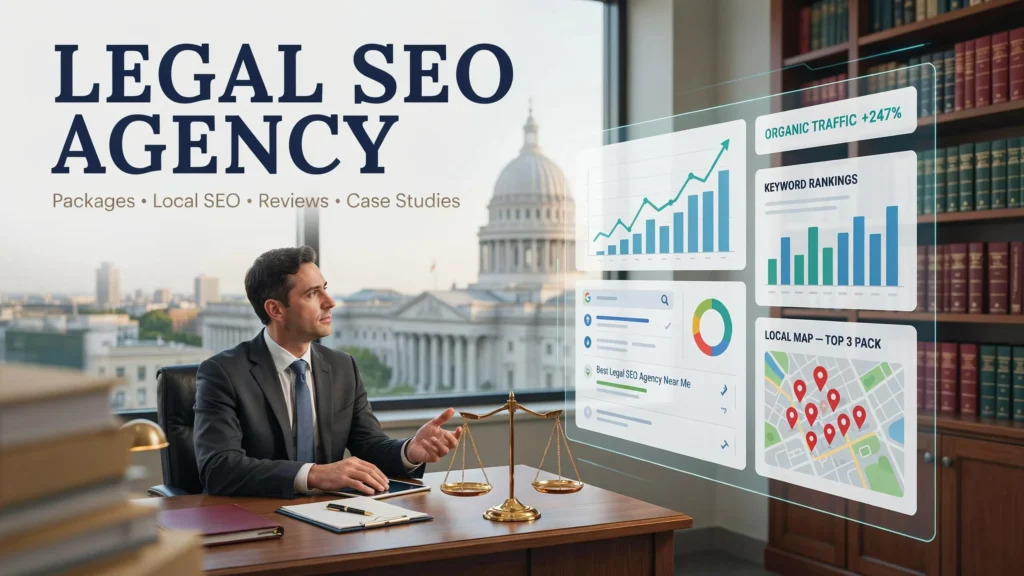
A legal SEO agency manages three interlocking systems for your firm: your Google Business Profile (GBP) and local map pack presence, your website’s technical and content structure, and the signals that establish your firm as a credible, authoritative source in your practice area and market.
The Google Business Profile is your listing in Google Maps and the local map pack, the three-result block that appears above organic listings for searches like “divorce lawyer” or “car accident attorney near me.” Ranking there depends on three documented factors: proximity to the searcher, relevance of your listing to the query, and prominence, meaning review volume, review quality, and overall web presence. Google’s own guidance on managing your Business Profile category confirms that category selection directly affects local ranking, which is why a generalist agency guessing at categories can quietly cap a firm’s visibility for months.
Website structure matters just as much. This includes schema markup, structured data using types like LegalService, Attorney, and FAQPage that tell search engines and AI crawlers exactly what your page is about, rather than making them infer it. If your firm hasn’t had its site reviewed for this kind of structural gap, our Legal SEO/GEO/AEO service breaks down what’s missing before anything else changes.
What Legal SEO Agency Packages Typically Include
Most legal SEO agency packages bundle four to six core services: GBP management, on-page and technical SEO, content production (practice area pages, blog articles, local landing pages), link building or citation building, and monthly reporting tied to rankings, traffic, and lead volume.
Pricing varies widely by market competitiveness and practice area, a solo estate planning attorney in a mid-sized market and a five-partner mass tort firm competing nationally are not buying the same service, even if both packages are labeled “SEO.” As a rough, hedged range, monthly retainers for law firm SEO typically fall somewhere between the low thousands and the high five figures, with the highest tiers reserved for competitive practice areas like personal injury in major metros. Anyone quoting a firm number without knowing your market or practice area is guessing.
What should be included regardless of tier: a documented content strategy tied to actual client questions, not keyword-stuffed filler; technical SEO audits covering site speed and crawlability; and transparent reporting that separates rankings from actual case inquiries. Rankings without inquiries are a vanity metric.

Legal SEO Agency Near Me vs. a National Specialist
Searching “legal SEO agency near me” assumes proximity matters for the agency the way it matters for your clients, but it doesn’t, your SEO team doesn’t need to be in your city to manage your GBP, write your content, or build your site’s authority.
What actually matters is whether the agency understands legal marketing specifically: state bar advertising rules, YMYL (Your Money or Your Life) content standards Google applies to legal and financial pages, and the practice-area nuances that separate a personal injury firm’s content needs from an immigration firm’s. A local generalist agency that also handles restaurants and HVAC companies will often know your city well and your industry poorly. A national legal-only specialist trades local familiarity for depth in exactly the rules and standards that govern your content.
Neither model is automatically superior. If proximity matters to you for in-person strategy sessions, weigh that against the specialist knowledge a legal-focused agency brings to compliance-sensitive content, a real trade-off worth naming rather than assuming your way past.
What Legal SEO Agency Reviews and Case Studies Actually Tell You
Reviews and case studies are useful for pattern recognition, not proof of future results, a five-star review tells you a client was satisfied with communication and process, not necessarily that the same tactics will work in your market against your specific competitors.
Read reviews for specifics: does the client mention what actually changed (map pack position, organic traffic, lead volume) or only that the team was “great to work with”? Vague praise is easy to write and doesn’t tell you much. Case studies deserve the same scrutiny. A legitimate case study names the starting point, the timeframe, and the practice area, and it acknowledges variables outside the agency’s control, competitive shifts, algorithm updates, seasonal demand. A case study with no timeframe and no caveats is marketing copy, not evidence.

It’s also worth asking directly what didn’t work on a past engagement. You can read more about how our team approaches transparency in reporting on our about page, an agency willing to discuss a campaign that underperformed, and why, is giving you more useful information than a highlight reel ever will.
State Bar Advertising Rules and Compliance
Every piece of content a legal SEO agency produces for your firm needs to comply with your state bar’s advertising rules, which in most states track closely with the ABA Model Rules governing communications concerning a lawyer’s services, particularly the prohibition on false or misleading claims.
This has direct SEO implications. Content that implies guaranteed outcomes, exaggerates results, or uses testimonials in ways your state restricts isn’t just an ethics risk, it’s also the kind of thin, hedge-free content that AI answer engines and Google’s own quality systems increasingly deprioritize for YMYL topics. Compliant content and well-structured content overlap more than most firms expect: both require specific, checkable claims instead of vague promises.
Some states also regulate how case results and testimonials can appear on a website, including required disclaimers. A legal SEO agency without state bar familiarity may write content your marketing coordinator later has to flag to compliance, costing time an already tight production calendar can’t absorb.
Realistic Timelines and What Actually Speeds Things Up
No legitimate legal SEO agency can promise a ranking timeline, because Google’s algorithm weighs hundreds of signals that no outside party fully controls, and competitive legal markets shift constantly.
What genuinely helps a page get indexed and considered relevant sooner is unglamorous: complete, unambiguous coverage of the topic’s core entities, clean semantic structure, internal links that build topical depth across related pages, and content that fully answers a query so a reader, or an AI crawler, doesn’t need to search again. Firms chasing shortcuts, like buying links or publishing thin AI-generated pages at volume, tend to see gains reverse after the next core algorithm update. Slower, structurally sound work holds up.
In most competitive markets, meaningful movement in rankings and lead volume takes several months, not weeks, and results vary significantly by practice area and local competition. An agency that hedges this honestly is more trustworthy than one that doesn’t, not less.
Your Next Step: A Clear-Eyed Audit, Not a Sales Pitch
Choosing a legal SEO agency comes down to three questions: does this team understand legal-specific compliance and content standards, can they show specific, verifiable examples of past work, and are they honest about what SEO can and can’t promise on a timeline.
If you’re weighing options, the most useful next step isn’t a sales call it’s a technical and competitive audit that shows exactly where your firm currently stands: your GBP health, your site’s technical foundation, your content gaps against local competitors, and a realistic sense of what closing those gaps would involve. That’s the kind of information you can act on regardless of which agency you choose.
You can get in touch to request an audit no obligation, no inflated promises about how fast you’ll rank.
FAQ
How much does a legal SEO agency cost?
Monthly retainers typically range from the low thousands to the high five figures, depending on practice area competitiveness and market size, with personal injury and mass tort in major metros at the top end.
How long does legal SEO take to show results?
In most competitive markets, meaningful ranking and lead movement takes several months rather than weeks; timelines vary by practice area, market competition, and starting point.
Is a local legal SEO agency better than a national one?
Not automatically proximity doesn’t affect an agency’s ability to manage your GBP or write compliant content. What matters more is legal-marketing specialization and state bar familiarity.
What should be included in a legal SEO agency package?
At minimum: GBP management, technical and on-page SEO, practice-area and local content, citation or link building, and reporting that separates rankings from actual client inquiries.
Do legal SEO agencies need to follow state bar advertising rules?
Yes. Content and claims produced on a firm’s behalf still fall under that firm’s state bar advertising rules, and an agency unfamiliar with those rules creates compliance risk.
What’s the difference between legal SEO and general SEO?
Legal SEO accounts for YMYL content standards, state bar advertising restrictions, and practice-area-specific search behavior that generalist SEO tactics don’t address.